







.svg)

.jpg)













Uniform blog/One decision transforms marketing from cost center to profit center
One decision transforms marketing from cost center to profit center

One decision transforms marketing from cost center to profit center
TL;DR
AI alone does not turn marketing into a profit center unless it is built on a composable DXP that removes delivery bottlenecks. Many organizations gain only isolated efficiency improvements while disconnected systems still slow content, personalization, and testing. The key takeaway: embedding an AI agent in a composable, agentic architecture like Uniform helps marketing teams launch, optimize, and scale revenue-driving experiences without constant dependence on developers.
McKinsey's research identifies sales and marketing as the single largest source of economic value from generative AI, at 28% of the total, more than software engineering, customer service, or R&D. Yet most organizations are not capturing this value. 88% are experimenting with agentic AI, while 81% report no meaningful bottom-line gains.
The architecture determines the ceiling
Many marketing organizations attempt to layer AI capabilities onto platforms that were not designed to support them.
An AI agent cannot personalize what it cannot reach in disconnected content repositories. It cannot optimize what it cannot test without a development ticket. It cannot accelerate campaign delivery when every content change requires engineering coordination.
The result: marketing teams adopt AI tools and see marginal efficiency improvements in isolated tasks, like faster copy generation, automated image tagging, and summarized analytics reports.
However, the organization's revenue trajectory does not change because the underlying architecture still manufactures the same friction between marketing intent and execution.
AI accelerates individual tasks, but workflow bottlenecks remain.
Why incremental AI adoption fails to move the revenue line
A familiar pattern has emerged across industries: organizations invest in AI-powered features within their existing platforms, expecting transformation from augmentation. However, this same monolithic DXP with an AI copilot bolted on still requires the same approval workflows, the same developer queues for personalization rules, and the same multi-week cycle from campaign concept to live experience.
Marketing teams end up with faster drafts sitting in the same slow pipeline. The AI generates content in minutes, yet it still takes weeks to reach the customer because the architecture between creation and delivery has not changed. Every handoff, every ticket, and every environment-specific deployment step absorbs the speed that AI was supposed to deliver.
The distinction matters: AI applied to tasks produces efficiency. AI embedded in architecture produces revenue.
The architectural decision that changes the financial model
Uniform's composable DXP restructures the relationship between marketing teams, engineering resources, and customer-facing experiences.
Instead of routing every content decision through a development queue, marketing teams assemble campaign experiences from connected data sources (product catalogs, content repositories, customer data platforms, digital asset libraries) in a single Visual Workspace, without writing code or filing tickets. Over 70 pre-built integrations connect existing martech investments without custom glue code, so the platform orchestrates whatever tools an organization already owns.
When Uniform's AI agent operates within this composable environment, the economics shift.
Scout can access every connected data source, assemble components without developer intervention, configure personalization rules from a conversation, and launch A/B tests autonomously.
Marketing organizations move from one major campaign per quarter to multiple personalized variants per week, directly increasing conversion rates, average order values, and customer lifetime value.
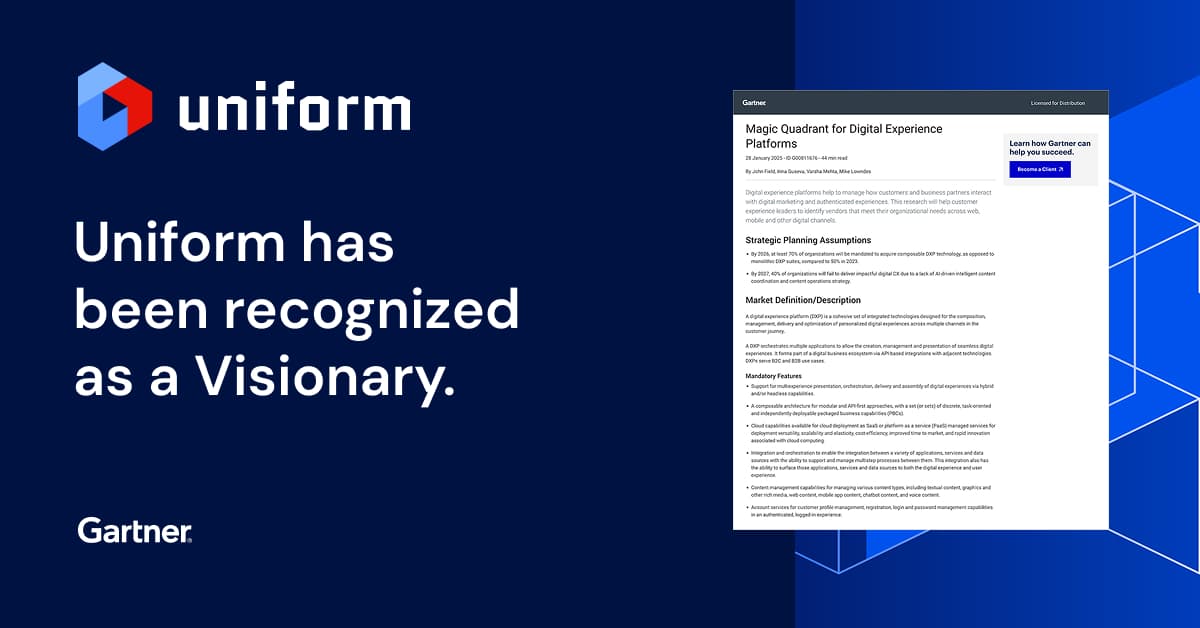
Gartner's 2026 Innovation Insight on Agentic CMS identifies composable modular architecture as the structural requirement for the shift toward agentic AI interfaces. Organizations without this architectural foundation will not fully participate in the transition.
Uniform is built on that foundation. Organizations adding chatbot features to a platform that still requires a developer for every content change are investing in the wrong layer.
From cost reduction to revenue generation
The profit center transformation happens when marketing organizations stop measuring AI success by hours saved and start measuring it by revenue generated.
This measurement becomes possible when the architecture supports three capabilities simultaneously:
- Launching personalized experiences without developer dependency
- Testing and optimizing those experiences continuously
- Scaling what works across markets and channels in hours instead of weeks.
Marketing teams operating on Uniform shift from requesting campaigns to running them, from planning quarterly experiments to launching them daily, and from reacting to past performance data to actively shaping future revenue.
More than just investing in AI, it is crucial for organizations to invest in the architecture that enables the AI to generate revenue. When the friction between marketing speed and engineering capacity disappears, marketing stops waiting and starts producing.
This decision determines whether marketing remains a cost center that spends budget or becomes a profit center that creates it.
FAQs
Vendors are layering AI capabilities onto platforms that were not designed to support it. The problem lies in architecture, not the AI itself. When marketing teams adopt AI tools without restructuring their underlying systems, they achieve only marginal efficiency improvements in isolated tasks—such as faster copy generation and automated tagging—but the organization's revenue trajectory remains unchanged.
Without an architectural foundation that eliminates developer dependencies and workflow bottlenecks, AI-generated content still gets trapped, negating the speed advantages AI was supposed to deliver
.jpg&w=3840&q=75)
Gartner® Reports
Innovation Insight: Agentic CMS