

Uniform orchestrates composable stacks without the bespoke integration code holding them together. Connect any content, commerce, data, or API by configuration, map source data to front-end components in clicks, and keep every layer reusable. Let an AI agent reach across your whole stack.

Most composable implementations connect API-first systems through bespoke code, hardening the stack into the rigidity it was meant to escape. The work distributes as a pyramid: a thin layer of assembly, some configuration, and a deep base of custom development you maintain forever. Uniform inverts this: assembly and configuration become the bulk of the work, done by those who own the outcome, and code shrinks to where it's needed.
Without Uniform, the work is a pyramid standing on a deep base of custom code, with configuration above it and a thin layer of assembly on top. With Uniform, the pyramid stands on its head: assembly is the widest layer, configuration sits below it, and code narrows to a sliver.
The long version of how stacks harden: the guide to what first-generation headless costs.
Integrations across CMS, commerce, DAM, PIM, search, CDP, AI, and delivery. Add credentials and go.
Any REST endpoint or GraphQL source connects without an integration at all. Add the connection and its data is usable in clicks.
GET https://api.yours.com/products
The integration SDK turns anything else into a first-class, reusable integration.
Content in Uniform's own CMS needs no connection at all: every content type is ready to compose. See Uniform's CMS
Get access to the source system and work out its APIs.
Write bespoke fetch-and-reshape code in every front-end component that touches the source.
Code which source fields land in which component fields.
Register the component and its data logic in the system that manages the experience.
Place the component on pages, as the step is too technical for marketers.
Time: hours to days. A second source for the same component means duplicating the code and repeating every step.
Create a data binding from the front-end component.
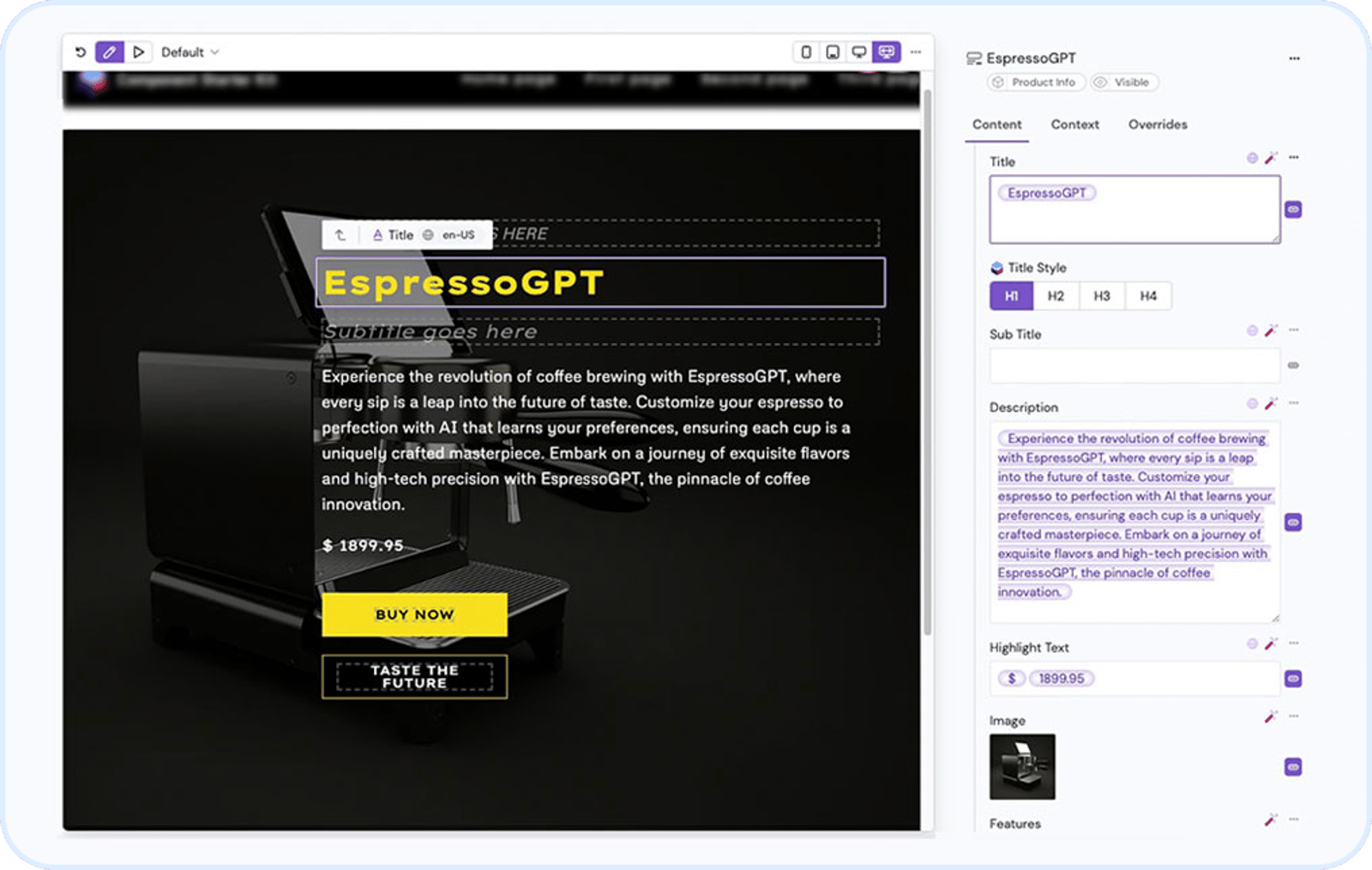
Pick the source, and visually map which data fills which fields.
Set permissions for where the component can be used.
The component is ready for anyone to use.
Time: minutes. The same component re-maps to any source on the same code base.
Reusable mappings compound: map once against an example entry, and every future use just picks its entry.
Without a deliberate model, composable stacks decay predictably: the content model starts mirroring the components, design flags leak into entries, and soon neither the content nor the components can be reused anywhere else. Uniform's experience model keeps four things separate and mapped: the content model (clean, domain-only), the components (presentation, source-agnostic), the data and context (commerce, customer data, signals), and the mappings that bind them per use. Content stays free of design decisions and channel assumptions, components stay ready for any source, and every layer of the stack (models, presentation, data) becomes independently reusable and independently replaceable.
Change any system, rebuild nothing. What that is worth to the business
Where presentation context should live, and why: the clean-models argument in full.
The content model holds only domain content, with no design flags and no channel assumptions. The components hold presentation and stay source-agnostic. The data and context layer holds commerce data, customer data, and signals. Nothing binds them permanently. A mapping binds them per use, which is why any one of the three can be replaced without rebuilding the other two.
Every platform now has an agent. What separates them is reach: an agent that can only touch its own vendor's repository automates a silo. Scout acts across everything Uniform orchestrates. The connected sources, the mapped components, and the composed experiences are all surfaces Scout can read, reason over, and change, with humans approving what ships.
Bulk operations, audits, personalization rollouts, and experience assembly work across content wherever it lives, including CMSs. Uniform orchestrates rather than stores.
Coding agents and external tools work against live schemas and real composition via the Model Context Protocol, so generated work matches reality rather than stale docs.
How MCP works for content managementThe same structured composition renders experiences for people, and clean, addressable content for the answer engines and buying agents acting on their behalf.
How to make content AI readyNot only does composability dissolve glue code, it's the answer to trapped agents.
Because sources connect by configuration and components bind by mapping, replacing a system underneath is reconfiguration, not a rewrite: the front end, the experience model, and the composed experiences survive the change. Adopt new systems at your own pace, exit old ones without a rescue project, and stop letting platform decisions hold the experience roadmap hostage.
We develop once. It's low-code, no-code; you're just registering your design system in Uniform and assembling the components easily, so we can build hundreds of patterns now with ease.
Uniform has been a certified MACH Alliance member since 2021: composability was the founding architecture, not a later positioning. With Uniform, there are options at every layer of the stack (CMS, commerce, DAM, PIM, CDP, CDN, AI services) and at every partner decision, because nothing about the implementation is proprietary to one vendor's way of wiring things.
Read the membership announcementThe questions architects and developers ask when they are working out what an orchestration layer actually does, and how it sits above the systems they already run.
Experience orchestration is the coordination of content, data, commerce, and presentation across multiple systems into coherent digital experiences. Uniform orchestrates through configuration: sources connect in clicks, data maps visually to front-end components, and the composed experience is managed in one place, without bespoke integration code between systems.
Middleware and iPaaS move data between systems; Uniform orchestrates experiences on top of systems. Data stays in its sources and is composed at delivery time into pages, apps, and channels, with visual editing, personalization, and result testing. You are not synchronizing databases; you are assembling what customers actually see.
Glue code is the custom integration code that composable stacks usually depend on: fetching, reshaping, and binding data from each system into each component, duplicated per channel. Uniform replaces it with configuration: connections in clicks, visual data-to-component mappings, and reusable bindings, so code is reserved for building components, not plumbing.
What first-generation headless actually costNo. Uniform connects the systems you already run (CMS, commerce, DAM, PIM, CDP, search) and orchestrates them as they are. Systems remain independently replaceable underneath: swapping one later is reconfiguration rather than a rebuild, which is the point of keeping orchestration separate from the systems themselves.
Orchestration defines an agent's reach. Scout, Uniform's agent, can act across everything Uniform orchestrates, including content in other vendors' systems; humans approve what ships, and MCP exposes the composed stack to coding agents and external tools. An agent confined to one repository automates a silo; an orchestrated one works the whole estate.
Bring one API we have never seen. We will map it to a component together, live.
Not a slide tour of the platform. We connect a source you own, map its data to a real front-end component while you watch, and you keep the recording.
Which systems hold your content, your products, and your customer data, and where the glue code between them costs you most today.
One of your sources connected live, then its data mapped to a real front-end component, in clicks, in front of you.
A straight answer on fit, a recording to share with your architects, and no follow-up sequence.
Not ready to talk to anyone? Fair. Try Uniform or read what first-generation headless cost no meeting required.