






.svg)

.jpg)











Uniform blog/Why headless CMS preview implementation takes days instead of hours
Why headless CMS preview implementation takes days instead of hours
.png&w=256&q=75)
Why headless CMS preview implementation takes days instead of hours
TL;DR
Implementing preview functionality in a headless CMS can often take days instead of hours, revealing hidden technical challenges that drain developer resources and slow down marketing teams. These delays create ongoing integration costs and hinder business agility. The key takeaway: platforms like Uniform, with configuration-driven preview and a Visual Workspace, eliminate debugging tax and empower teams to focus on innovation, not maintenance.
Marketing organizations adopt headless CMS platforms specifically to escape the constraints of monolithic systems. Technical flexibility becomes the promise that justifies migration budgets, developer retraining, and workflow disruption. Preview functionality becomes the constraint that reveals whether platforms deliver on architectural promises or simply relocate technical debt.
Development teams discover their thirty-minute documentation task extends to three-day debugging marathons while competing organizations using configuration-driven platforms launch campaigns, run experiments, and optimize results during the same seventy-two hours. Software developers spend 35-50 percent of their time validating and debugging software, and preview implementation becomes a microcosm of the integration tax that separates market leaders from organizations perpetually catching up.
Documentation promises collide with production reality
Headless CMS documentation presents preview as straightforward configuration. Technical architecture appears sensible. Teams allocate sprint stories accordingly, estimating half-day tasks based on documentation promising to initialize SDK, configure webhooks, and set preview URLs. Thirty minutes for basic projects, an hour for complex implementations.
Production introduces complications that documentation omits:
- Modern React frameworks handle previews differently across routing approaches, creating framework-specific edge cases that require separate debugging sessions
- Incremental static regeneration creates caching conflicts with preview cookies
- Security headers prevent iframe embedding
- Authentication tokens require environment-specific configuration across development, staging, and production
- Framework evolution breaks existing configurations, and migration guides address routing changes but omit preview implications
Stack Overflow threads reveal the scale. Developers encounter "Failed to apply live update" errors without diagnostic paths. Preview mode cookies fail to persist across redirects. Content transformations break live updates because the SDK requires untransformed data structures. Teams discover requirements buried in documentation only after implementation fails, then spend days reconstructing functionality that worked in previous versions.
The thirty-minute task becomes a three-day debugging marathon, navigating framework gotchas, security policies, and webhook reliability. Engineers spend an average of 13 hours to fix a single software failure, with 41% identifying bug reproduction as the primary barrier.
Production-ready preview requires solving undocumented problems
Preview functionality demonstrations succeed in controlled environments. Production deployment reveals requirements that basic setup guides often overlook. Teams discover documentation omits critical production concerns:
Draft content security: Public preview URLs that do not require authentication allow search engines to index unpublished content. Teams implement access controls, authentication layers, and URL obfuscation absent from documentation. Security policies enable development previews while blocking staging deployments.
Multi-environment coordination: Preview configurations differ across development, staging, and production. Environment variables proliferate. Webhook endpoints require separate setup. Previewing locally fails in staging because Content Security Policy restrictions are not documented in the setup guides.
Editor workflow gaps: Preview loads in a separate browser window, breaking editor context. Inspector mode requires manual data attribute tagging across every component. Content updates trigger refresh delays, frustrating non-technical users. Technical preview works, but the editor experience falls short of traditional CMS inline editing.
Developers spend nearly 20 work days annually on tool failures, outages, and workflow problems, with 24% citing tool integration issues. Preview implementation exemplifies the integration complexity tax that platforms impose.
The compounding cost across teams and time
The initial three-day implementation represents only the first iteration. The debugging tax compounds through multiple channels:
Framework evolution overhead: Each framework upgrade breaks preview functionality. Application router evolution required a complete reimplementation. Framework changes cascade into configuration adjustments requiring new debugging sessions.
Knowledge transfer friction: New developers encounter preview debugging without context from the initial implementation. Stack Overflow threads become institutional memory. Documentation drift between CMS updates and framework evolution creates knowledge gaps requiring experimental debugging.
Context-switching tax: Editor complaints pull developers from feature work. Preview loads slowly. Inspector mode breaks on specific content types. Webhook failures cause intermittent delays. Each issue interrupts development cycles for diagnostic sessions, prioritizing reliability over feature development.
Organizations measure cost in developer opportunity, which represents the work that does not happen because capacity is consumed by maintenance. A Canadian telecommunications provider implementing composable architecture achieved 60 times developer efficiency improvement and $1.1 million ROI by eliminating routine integration debugging. Efficiency gains reveal the opportunity cost of manual preview implementation, consuming developer capacity.
When preview becomes configuration instead of project
Uniform Scout transforms preview from an implementation project into a configuration by handling technical complexity through natural language. Development teams describe desired behavior conversationally, and Scout handles framework-specific implementation without debugging cycles.
The Visual Workspace provides preview without separate integration projects. Editors see real-time content updates within the editing interface. Multiple preview modes support different review workflows. Responsive testing switches between device views without additional configuration.
Framework-agnostic architecture eliminates debugging tied to specific rendering approaches. Preview works identically across React-based, Vue-based, and other supported frameworks because the abstraction layer handles implementation details. Framework updates do not break preview because teams upgrade without triggering reimplementation cycles.
Scout operates beyond the Uniform interface through Slack integration and CI/CD pipeline integration. Teams maintain preview functionality within existing collaboration tools without context switching.
Production-ready preview includes capabilities that basic documentation treats as optional. Content security enforcement automatically prevents unauthorized access. Multi-environment coordination handles development, staging, and production configurations without manual setup. Editor workflows optimize for non-technical users rather than developer convenience.
The transformation eliminates debugging tax entirely. Development teams reclaim days previously spent on preview setup, framework upgrades no longer trigger reimplementation, and editor support requests decrease because reliability improves through tested abstractions. A German fintech firm achieved a 15% registration conversion lift while increasing experiment velocity by 500% because developers focused on optimization rather than preview maintenance.
The preview implementation as platform signal
Organizations evaluating headless CMS platforms focus on feature checklists while overlooking implementation complexity. Preview functionality reveals architectural philosophy. Platforms designed for composability provide preview through configuration. Platforms retrofitted for headless workflows require custom implementation that accumulates as technical debt.
Three-day debugging cycles for basic preview signal broader integration challenges. When preview requires custom code, the pattern repeats across personalization, testing, localization, and workflow features. Framework upgrades introduce regression risk because custom implementations diverge from platform evolution. Technical debt compounds as teams maintain preview alongside dozens of other custom integrations.
Configuration-driven preview indicates different architectural approach. When preview works identically across frameworks without custom code, the abstraction layer handles complexity properly. When editors use preview without developer support requests, the platform addresses production requirements rather than technical demonstrations. When framework upgrades do not break preview, the platform separates concerns correctly, which means the architecture was designed for composable workflows rather than retrofitted from traditional CMS patterns.
Organizations evaluating platforms should measure preview implementation as technical due diligence:
- Allocate one developer for proof-of-concept preview setup
- Document actual hours from documentation to production-ready functionality
- Test framework upgrade stability
- Survey editors on usability without developer support
The difference between thirty minutes and three days means the difference between platforms enabling velocity and platforms taxing capacity indefinitely. Teams spending three days debugging preview spent this time not building features, optimizing conversion, or launching campaigns. Competitors using configuration-driven preview launch while others debug. The velocity gap compounds across quarters, creating competitive separation that market position cannot recover because the platform architecture determines execution capacity.
Schedule your demo now and reclaim those lost preview days for actual innovation.
FAQs
Preview implementation appears simple in the documentation; therefore, teams estimate it as a half‑day project. In production, they hit undocumented issues. Each framework evolution can also silently break existing preview integrations. The result is a multi‑day debugging marathon instead of a quick configuration change.
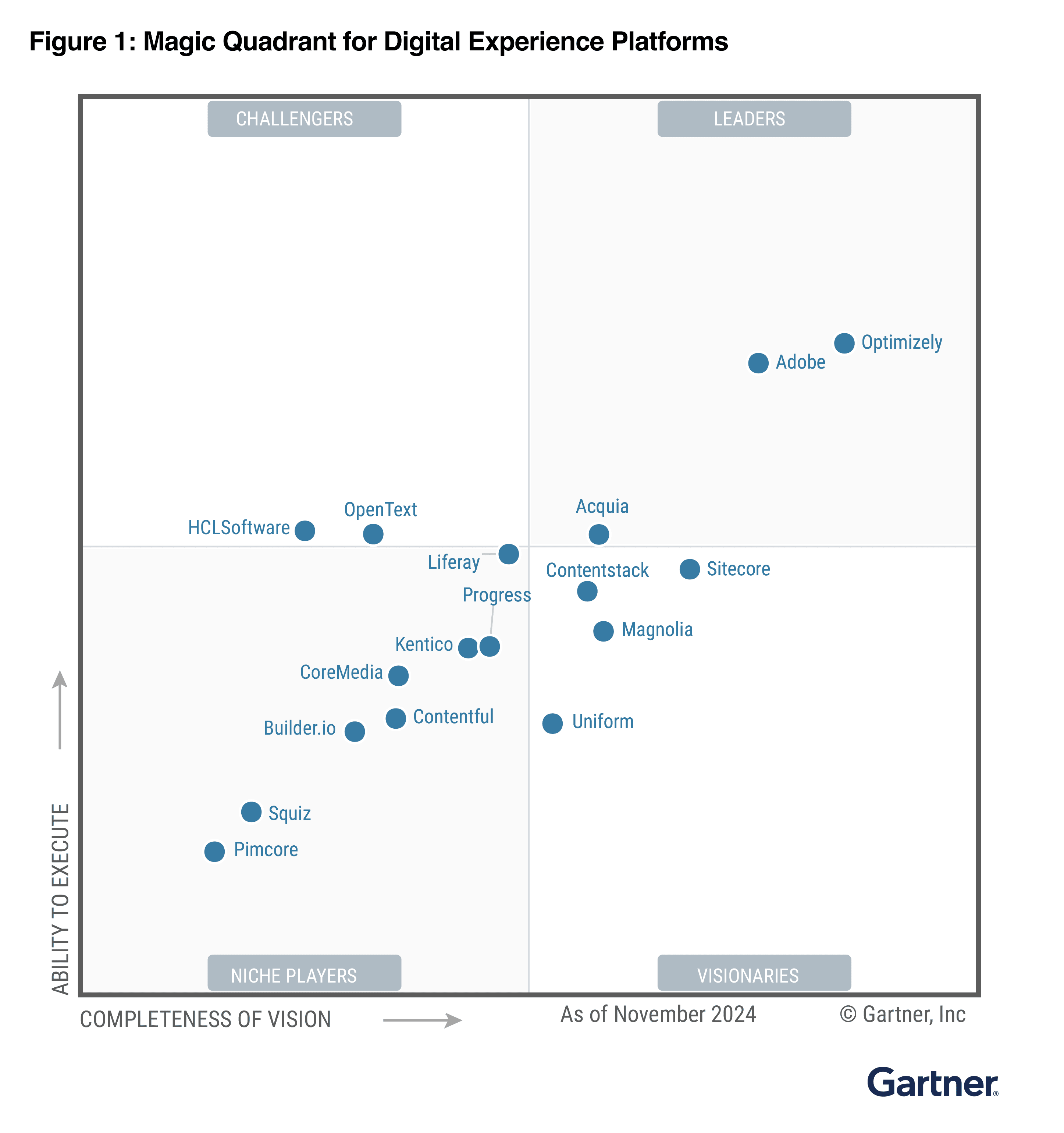
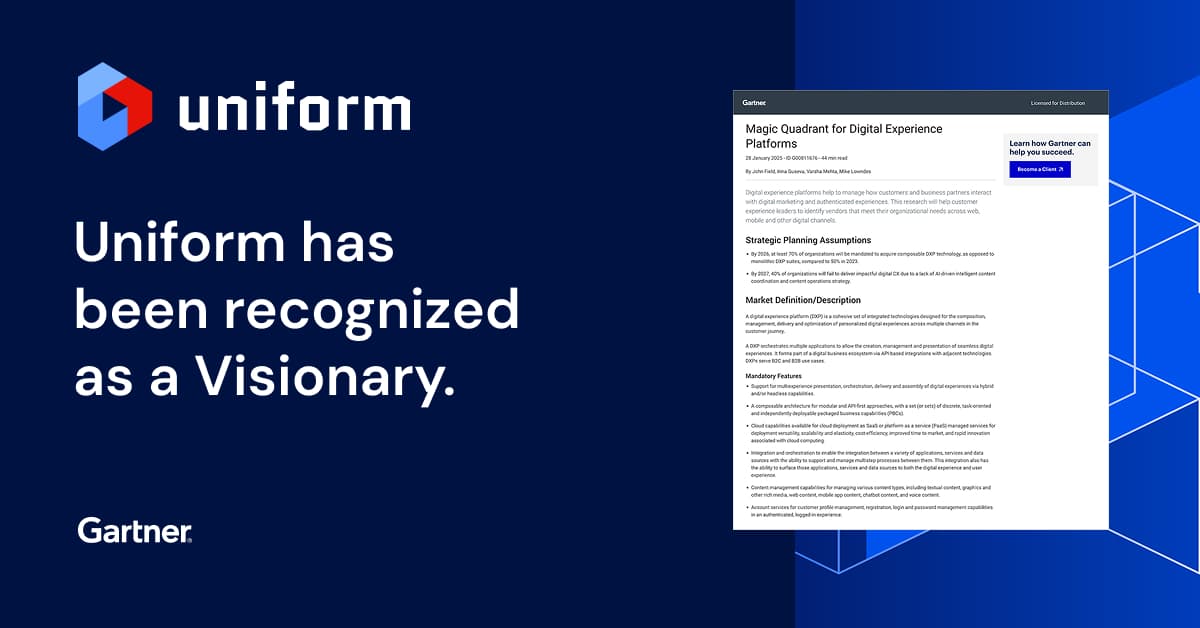
Uniform Recognized as a Visionary in 2025 Gartner® Magic Quadrant™ for Digital Experience Platforms
Learn More
.png&w=1080&q=90)