






.svg)

.jpg)














Uniform blog/Why architecture matters more than features when choosing a DXP
Why architecture matters more than features when choosing a DXP

Why architecture matters more than features when choosing a DXP
TL;DR
Selecting a digital experience platform (DXP) based on architecture, rather than feature checklists, leads to greater long-term value and efficiency. Integration architecture, composable foundations, and reduced organizational friction ultimately control total cost of ownership and business agility. The key takeaway: architecture—not features—determines whether a DXP empowers teams, scales efficiently, and adapts to change.
Every vendor on a DXP shortlist passes the feature checklist.
- Personalization
- A/B testing
- Content management
- Integrations
- AI capabilities
Features are no longer the differentiator. Architecture is.
Organizations that evaluate on feature parity consistently build stacks that cost more, perform worse, and break faster than expected. Ascend2's 2025 "State of Your Stack" survey found that 65.7% of organizations cite data integration as their biggest martech stack challenge
Not functionality, not cost, not features.
The capabilities most likely to cause failure are the capabilities least likely to appear on a vendor scorecard.
Why do feature comparisons fail for DXP evaluation?
Feature matrices reward breadth over depth. A platform that delivers personalization through server-side rendering and a platform that personalizes at the CDN edge both receive the same checkmark. A platform with a dozen pre-built integrations and a platform with over 70 no-code integrations both show "integrations: yes."
The matrix cannot capture how features perform inside a connected architecture, how they scale under production traffic, or how much custom code they require to deliver the outcomes the demo promised.
Architecture determines three things that features cannot: how systems connect without custom glue code, how the martech stack evolves when business needs change, and how much organizational friction the platform manufactures between marketing and engineering.
McKinsey's 2025 research found that 47% of decision-makers cite stack complexity and poor data integration as the primary barriers to value realization. None of the 50-plus senior marketing leaders McKinsey interviewed could quantify the ROI of their martech investments. Feature-rich stacks without architectural coherence generate activity metrics instead of business outcomes.
Practitioners estimate that most CMOs underestimate their true martech costs by 40 to 60 percent because feature-led evaluations treat license fees as total cost of ownership. Integration engineering, implementation, maintenance, middleware, and dedicated headcount transform a $200K to $600K annual license into $500K to $1.5M in operating cost for mid-market organizations. Architecture-first evaluation forces that math into the open before the contract is signed.
What should organizations evaluate instead of features?
Architecture-first evaluation subordinates features to structural fit. Rather than asking "does this platform offer personalization," the evaluation asks how personalization decisions are executed, where they are processed, and what performance cost they carry.
Three architectural dimensions separate platforms that deliver from platforms that demo well.
Integration architecture. How does the platform connect to existing systems, and at what ongoing cost? Platforms with pre-built integrations and open APIs reduce the need for custom development, which can become a permanent cost center. Uniform connects over 70 systems across CMS, DAM, CDP, commerce, and analytics categories through configuration rather than custom code, enabling marketing teams to access federated content without waiting for engineering cycles.
Composability at the foundation. Was the platform designed as composable from inception, or was composability retrofitted onto a monolithic core? Retrofitted composability reveals itself during implementation as unexpected constraints, rigid content models, and integration limitations invisible during the demo. Uniform was architected for composability at every layer, treating content, data, and presentation as independent, interchangeable capabilities rather than features bundled into a single vendor ecosystem.
Organizational friction. Does the architecture create or remove the dependency loop between marketing and engineering? Platforms that require developer involvement for content updates, personalization rules, and campaign launches create ticket queues that extend campaign timelines from days to weeks. The Uniform Visual Workspace enables marketing teams to assemble experiences from connected data sources, run A/B tests, and configure edge personalization without filing development requests, while developers retain full control over components and front-end code.
Does the evaluation change for orchestration versus full platform replacement?
The architectural questions remain the same. The weight assigned to each answer changes.
When the goal is orchestrating an existing martech stack, the integration architecture carries the most weight. The platform must work with what already exists without forcing migration, replacement, or re-implementation. Uniform's "Better Together" deployment model sits on top of existing CMS, DAM, CDP, and commerce investments as a composition and optimization layer. Content stays where it lives. Edge personalization, A/B testing, and AI-powered content operations layer on top of the current stack via configuration rather than custom development.
When the goal is full platform replacement, migration velocity and time-to-value carry the most weight. The critical question: how quickly can the organization reach production without disrupting campaign continuity? Uniform operates as a complete DXP with its own CMS, personalization engine, testing framework, and AI agent. Uniform Siphon compresses migration timelines from months to weeks by using AI to analyze existing sites, infer content models, and reconstruct modern framework code without manual mapping or source code access.
The entry point into composable architecture differs based on existing investment, risk tolerance, and competitive urgency.
What questions reveal architectural fitness during vendor evaluation?
Five questions cut through feature parity and expose architectural reality.
- How many custom integrations does the platform require to connect with existing systems, and what is the ongoing maintenance cost per integration?
- Can marketing teams launch personalized experiences without developer involvement, and how does the platform ensure zero-flicker delivery at the edge?
- When the organization needs to replace a single component of the stack, does the architecture support modular swap-out, or does one change cascade across the system?
- How does the platform handle content from multiple sources simultaneously, and does orchestration require custom code or configuration?
- What is the migration path from the current platform, and how does the vendor minimize content freeze windows during transition?
Vendors that answer with architectural specifics rather than feature descriptions demonstrate the foundation that separates delivery from demos.
Stop Guessing on Architecture. Get Clarity on Cost.
Most organizations discover the true cost of their martech stack only after contracts close. You don't need another feature matrix. You need to know where architecture will cost you money and where composable infrastructure will recover that cost.
FAQs
Feature-led evaluations treat license fees as the primary cost, ignoring integration engineering, custom development, middleware, and ongoing maintenance. License fees represent roughly one-third of what organizations pay for martech; integration, headcount, and maintenance absorb the rest. Architecture-first evaluations model total cost before the contract closes.
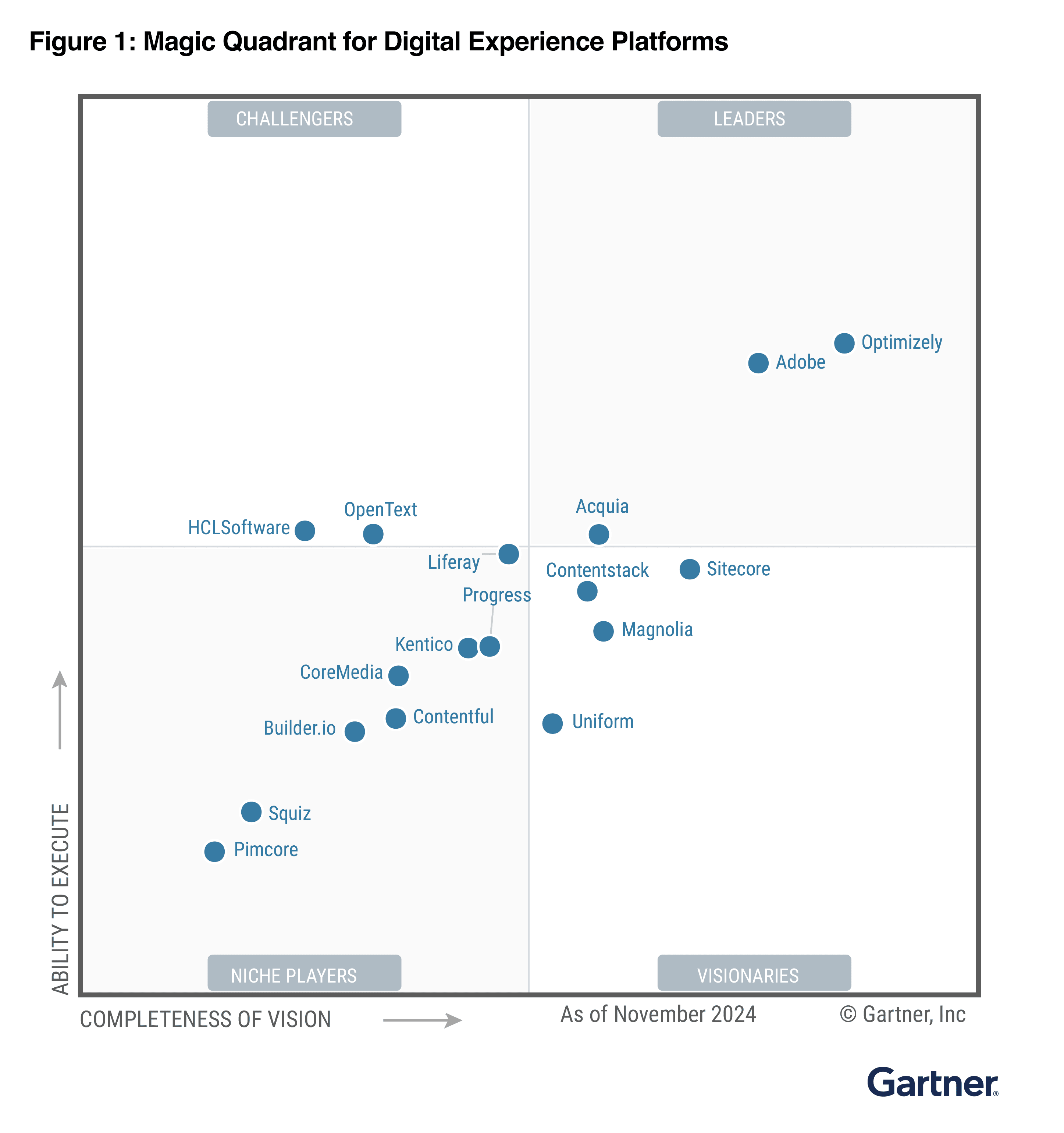
Uniform Recognized as a Visionary in 2025 Gartner® Magic Quadrant™ for Digital Experience Platforms
Learn More