






.svg)

.jpg)












Uniform blog/Speed-to-market isn't a feature, it's a survival skill
Speed-to-market isn't a feature, it's a survival skill
.png&w=256&q=75)
Speed-to-market isn't a feature, it's a survival skill
TL;DR
Legacy digital platforms create bottlenecks that slow campaign delivery and limit marketing agility. By adopting composable architecture and tools like the Uniform Visual Workspace and AI agents, organizations free their marketing teams from developer dependencies, drastically increasing speed-to-market. The key takeaway: execution velocity is now a survival skill—teams that remove technology barriers can continuously test, learn, and outpace competitors.
Organizations losing market position rarely see the moment it happens. Revenue is the trailing indicator. What registers first is the campaign that launched three weeks after the competitive window closed, the personalized experience that required four development tickets to update, and the product page that went live two days after the competitor's.
The cause is architectural. The gap between what a marketing team can conceive and what the technology infrastructure allows it to execute without engineering support determines how fast an organization can actually move.
Most organizations built their digital experience delivery on platforms designed for stability rather than velocity. Those platforms consolidate content, commerce, and publishing logic into a single system where every editorial change flows through developer-controlled deployment pipelines. The result is a workflow where a marketing manager with a campaign idea cannot act on it without filing a request, waiting for sprint capacity, and reviewing the finished work days or weeks later. The architecture makes speed structurally unavailable to the people driving revenue.
Why the developer bottleneck compounds
Every campaign waiting in the development queue is a test that did not run, a segment that did not receive a tailored experience, and a market moment that passed without a response. Velocity is about closing the gap between idea and execution before the opportunity expires. On most platforms, that gap is structurally built in.
BCG research from 2024 found that organizations using a modern, modular technology stack can shorten their time from product concept to launch by more than five months.
The architectural response is composable architecture, a model in which the content layer, the experience delivery layer, and the data integration layer operate independently. When those layers are decoupled, marketing teams execute directly without waiting for engineering availability. The development team retains control over component architecture and governance. The marketing team gains direct authoring authority over the experience.
What changes when execution velocity is a design principle
Uniform implements this model as a composition layer that works with existing infrastructure rather than replacing it. Organizations connect their current CMS, DAM, commerce platform, and CDP through more than 70 pre-built integrations, with no custom development required to establish the connections. Existing content stays where it lives. What changes is the authoring layer on top of it.
The Visual Workspace consolidates those connected sources into a single canvas where marketing teams assemble, personalize, and publish experiences without switching platforms or filing development requests. A campaign page pulling content from a CMS, product data from a PIM, and audience segments from a CDP is assembled in one place, with real-time preview across devices and channels before a single configuration change ships.
Scout, Uniform's AI agent, handles multi-component assembly conversationally. A marketing manager can build a seasonal campaign layout, configure A/B test variants, and set personalization rules through natural language instructions, without touching the component library directly. The work that previously required a developer to structure stays within the marketing team's direct control.
Releases coordinate campaign launches across multiple compositions without engineering involvement in the scheduling or deployment sequence. A retail team running a product launch across a homepage, category pages, and regional landing pages publishes the full campaign in a single coordinated action with a pre-set go-live date.
What speed looks like at the delivery layer
Cobham Satcom built a full microsite in four weeks using Uniform, a project that would previously have required months of custom development coordination. The site launched on schedule. Leads increased 150% against the previous baseline. The speed was not an exception to their normal workflow; it became the workflow.
Uniform accelerated Taxfix's marketing productivity by eliminating engineering bottlenecks to enable rapid experimentation. With native personalization and A/B testing features in a single platform, the team could design, preview, and deploy complex experiments across devices and channels without requiring development support. Experiments increased by 500% year-over-year and the registration rate jumped by 15% during peak season.
Neither outcome came from working harder. Both came from removing the structural friction between marketing intent and live execution.
The compounding advantage
Organizations building launch velocity now are accumulating a testing and learning advantage that compounds over time. Every campaign generates data. Every A/B test produces a result that informs the next decision. Every personalization rule improves with each additional audience signal. Organizations still clearing development backlogs before they can run the first test begin that cycle later and fall further behind with each iteration.
Execution velocity is a capability that either exists in the architecture or it does not. Organizations that have not redesigned for it are not behind on a single campaign. They are behind on every campaign, cumulatively, in every quarter where the window opened and closed before the team was positioned to move.
Stop waiting for development capacity. Start moving at market speed. Discover how Uniform's composable architecture can transform your marketing velocity—schedule your personalized demo today.
FAQs
Uniform acts as a composition layer that connects to your current CMS, DAM, commerce platform, and CDP using 70+ pre-built integrations, leaving content where it lives and adding a Visual Workspace for marketers to assemble, preview, personalize, and publish across devices without developer tickets. It also includes Scout, an AI agent that enables conversational multi-component assembly and campaign coordination features like scheduled Releases

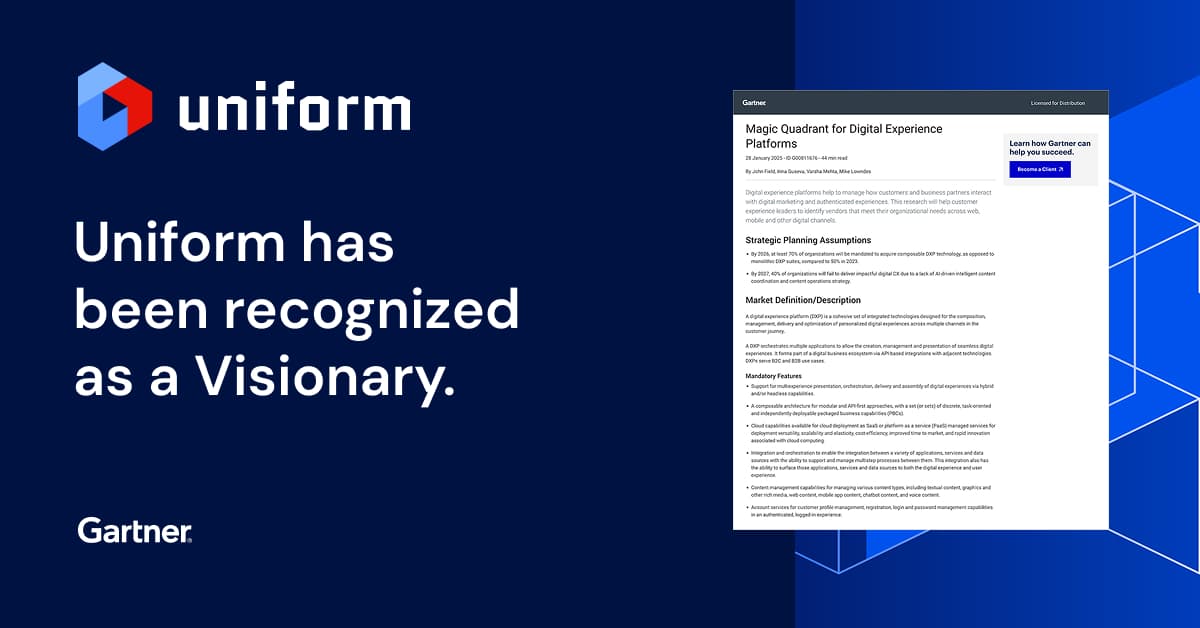
Uniform Recognized as a Visionary in 2025 Gartner® Magic Quadrant™ for Digital Experience Platforms
Learn More