





.svg)

.jpg)











Uniform blog/Why multiple AI agents can slow you down
Why multiple AI agents can slow you down

Why multiple AI agents can slow you down
TL;DR
Adding more AI agents to marketing stacks tends to increase complexity instead of efficiency. Fragmented tools lead to costly coordination and lost productivity, while unified platforms with native AI remove overhead by integrating automation, personalization, and campaign management. The key takeaway: consolidating to a single intelligent platform like Uniform streamlines workflows and unlocks AI's true potential for marketing teams.
The instinct to add AI everywhere is understandable. Agents promise faster content creation, automated personalization, smarter SEO, and copy at scale. The logic is airtight. More AI means more output.
The question worth pressure-testing before the next AI tool goes into the martech stack: when a marketing organization adds its fourth AI agent, does campaign velocity improve, or does the coordination overhead increase?
Marketing organizations treating AI capability as an additive exercise are discovering a familiar problem with new packaging: each agent has its own interface, its own prompt conventions, and its own context window. None of them communicate with each other. Yet, someone still has to translate between them.
The bolt-on pattern and why it compounds
When legacy digital experience platforms respond to the AI moment, the patterns are predictable.
- A content generation tool gets layered onto the publishing workflow.
- A separate SEO agent lives in another browser tab.
- A personalization engine requires its own configuration logic.
- Development teams receive API documentation and instructions to wire everything together themselves.
Each tool requires onboarding. Each requires governance. Each produces outputs in its own format, creating a translation layer that inevitably falls to a human in the middle.
The promise of AI-driven efficiency quietly becomes a coordination project.
The productivity loss from fragmented AI toolkits is measurable. A WalkMe enterprise study found that employees lose an average of 51 workdays per year navigating disconnected technology, spending it context-switching, re-entering prompts, and reconciling outputs across tools rather than doing the work those tools were supposed to accelerate.
The problem is not that the individual tools are weak; it is that the overhead of managing them compounds with each addition.
The market has noticed. Futurum Group's 2026 Enterprise Software Decision Maker Survey of 830 executives found that 66% now favor unified platform suites over best-of-breed stacks, and 41% are actively planning to consolidate their application footprint. Organizations that ran the multi-agent experiment are arriving at the same conclusion: coordination overhead grows proportionally with every tool added to the stack.
Why more agents is not smarter
Managing five AI agents to execute a campaign is roughly equivalent to hiring a separate chef for each ingredient in a recipe and expecting a coherent meal to emerge. The sous chef handles the garlic. Another handles the salt. Each is technically proficient. None of them know what the others are doing. The meal arrives incongruent, inconsistent, and significantly more expensive than advertised.
Marketing teams running disjointed AI toolkits face the same dynamic. The content agent does not know what the SEO agent recommended. The personalization tool does not know which components were created in the composition layer. Someone has to hold all of that context, and that person is usually the campaign manager who was supposed to be focused on strategy, not system integration. Every hour spent managing AI coordination is an hour not spent on the campaign itself.
What a native AI agent does differently
Uniform's Scout operates from inside the platform rather than alongside it. Scout carries automatic context awareness of the full project structure, every component, every composition, every data connection, because it was designed to understand the Uniform environment from inception rather than be retrofitted onto it.
When a marketing team needs to build a campaign page:
- Scout handles the component assembly conversationally, without requiring a development request.
- Localization happens in seconds. Scout translates entire compositions across 30+ languages while preserving component structure and context, rather than routing them through a separate translation workflow.
- SEO analysis is run on demand and fixes are implemented directly, not exported as a recommendations document that requires a separate action to address.
- Personalization criteria and A/B test variations are configured in natural language, eliminating the need for a separate tool, interface, and onboarding cycle that fragmented setups require.
Scout is accessible throughout the platform and maintains conversation history, so context from one session carries forward into the next. For teams operating in Slack or integrated CI/CD workflows, Scout is available there as well.
The distinction is architectural, not cosmetic. A native AI agent that understands the full stack eliminates the translation layer imposed by fragmented toolkits. Fewer handoffs. Fewer interfaces to govern. Fewer places for context to get lost between the intent and the execution.
The consolidation trend is already underway
Menlo Ventures' 2025 State of Generative AI in the Enterprise report tracked $660 million in marketing AI platform spend, making it the fastest-growing segment in enterprise software. Critically, 76% of enterprise AI deployments in 2025 were purchased as integrated platform capabilities rather than assembled from individual point solutions — a significant shift from 47% in 2024.
The market is moving toward consolidation precisely because organizations that ran the fragmented experiment learned the same lesson: coordination overhead scales with every tool added, which means the productivity ceiling gets lower, not higher, as the toolkit grows.
The organizations leading in AI-powered marketing are not running the most agents. They are running the right architecture: one platform, one agent with full-stack context, and one interface that the team learns once, with ownership and oversight of governance throughout the workflow. Native AI does not just simplify the current workflow; it removes the ceiling.
Stop managing five AI agents. Start running one intelligent platform. Learn more now.
FAQs
When a marketing technology requires more than one AI agent, coordination overhead will increase rather than improving campaign velocity. Each agent is siloed, requiring separate management, and the unification of output is needed. The productivity loss is measurable and compounds with every agent addition.
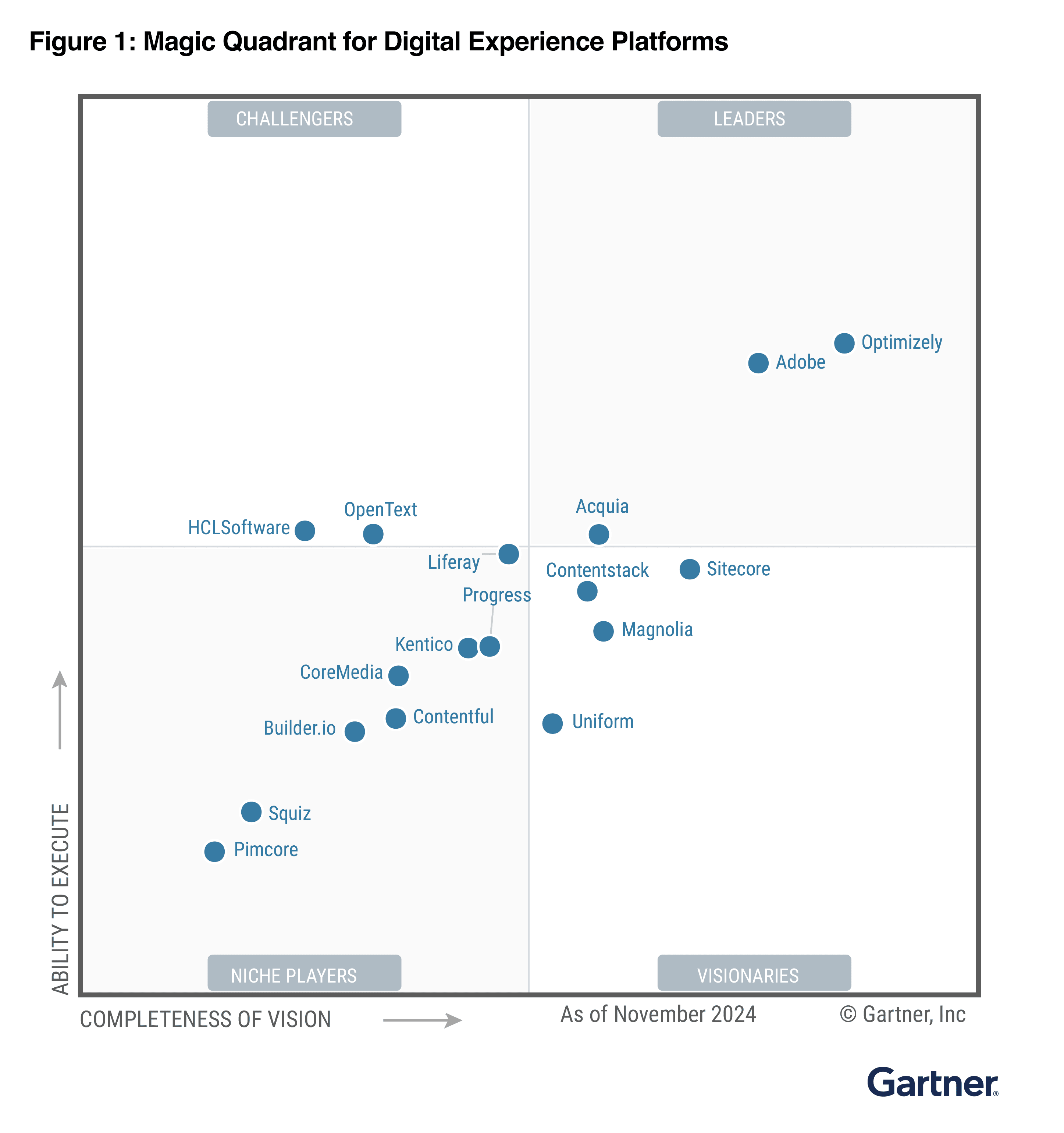
Uniform Recognized as a Visionary in 2025 Gartner® Magic Quadrant™ for Digital Experience Platforms
Learn More