




01 // Definition

How to make content AI-ready

Updated August 20269 minute read

DefinitionAI-ready content

AI-ready content is content that machines can reliably find, parse, trust, and act on: structured as typed entries rather than page blobs, semantically explicit, marked up for extraction, and accessible to AI agents through clean APIs and protocols such as MCP. Making content AI-ready is the prerequisite for both being visible in AI search and using AI agents in your own content operations.

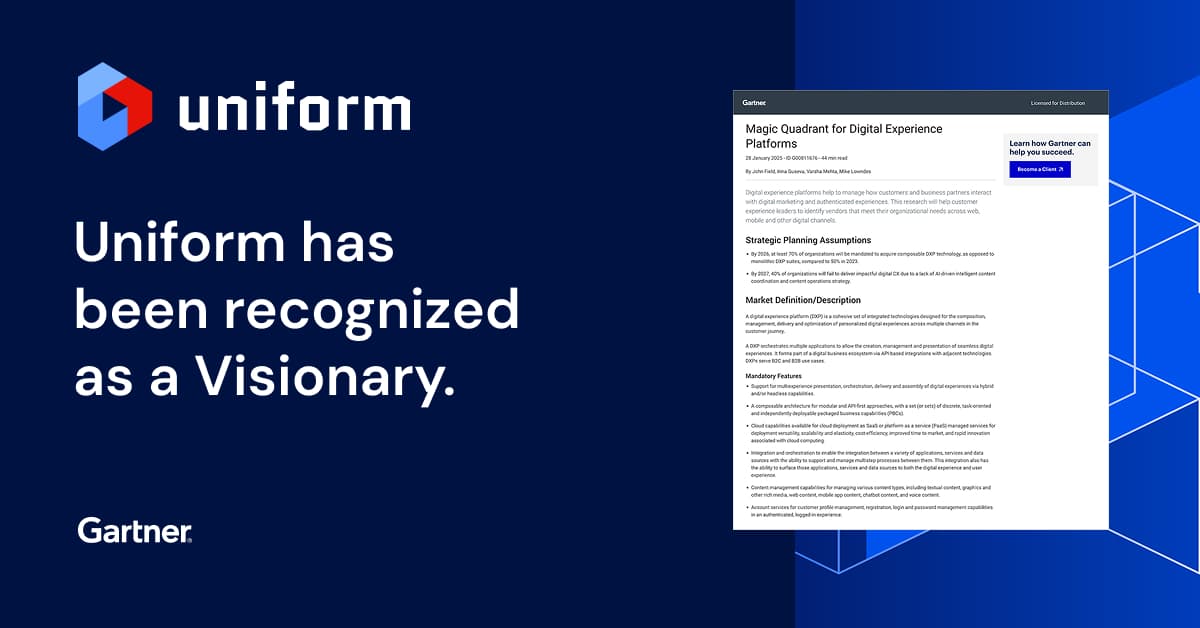
Two forces make this urgent at once. Outward: a growing share of discovery now happens through answer engines and AI assistants that summarize and recommend rather than send clicks, and Gartner® projects that by 2028, 80% of customer interactions will shift from web, search, social, mobile applications, and other traditional digital CX channels to agentic AI interfaces. (Gartner, Innovation Insight: Agentic CMS, Irina Guseva, Mike Lowndes, 12 May 2026).

Get the Gartner report

Inward: the same report identifies content and data readiness as a primary hurdle for teams adopting agentic tools, because agents are only as reliable as the structure underneath them. One fix serves both: the structure that makes your content quotable by ChatGPT is the structure that lets your own agents work without supervision.

TL;DR // 30 seconds

AI-ready content is content machines can find, parse, trust, and act on. The audit is five signs; the fix is seven steps, and the first two (typed entries, explicit relationships) carry most of the weight. The same work makes you quotable in ChatGPT and makes your own agents reliable.

02 // Audit

Is your content AI-ready? Five signs it isn't.

Run the audit before you make any changes. Each sign is fixable on its own, and most teams recognize at least three of the five.

Every sign has the same root cause: content shaped for a browser rather than for a machine.

  1. 01

    Your content lives in pages, not entries.

    If the only way to get product X's pricing is to scrape a rendered page, agents will guess, and sometimes guess wrong.

  2. 02

    Answers are buried.

    Key facts sit three paragraphs deep, behind storytelling intros. Answer engines extract the first clean sentence they find; if yours is extensive, it will be invisible or misquoted.

  3. 03

    No structured data.

    Pages carry no schema.org markup, so machines infer meaning from layout unreliably.

  4. 04

    Content is only reachable by humans.

    Everything requires a browser session; nothing is exposed through APIs or MCP, so agents cannot query it directly.

  5. 05

    You cannot answer "what does the AI say about us."

    Nobody monitors how the brand surfaces in ChatGPT, Perplexity, Gemini, or AI Overviews, so there is no feedback loop.

The seven steps below fix that cause in the order that compounds fastest.

03 // The steps

Seven steps to AI-ready content

Work in order. Each step makes the next one cheaper.

Steps one and two carry most of the weight. Start there.

  1. 01

    Model content as typed entries, not pages

    Break content into typed, reusable entries with explicit fields: a product has a name, price, and specifications; an FAQ has a question and an answer; an article has an author, date, and claims. Typed structure is what lets a machine answer "what is the return policy" without parsing prose. If you run a headless CMS, you likely have this foundation; the work is extending it to content still trapped in page builders and PDFs.

  2. 02

    Make relationships explicit

    Agents reason over connections: this article is about that product, written by this author, and superseded by that update. Model relationships as references between entries rather than hyperlinks in body text. Explicit relationships are also what keep AI answers current: update the source entry once, and every consumer, human or agent, gets the correction.

  3. 03

    Write answer-first

    For every page that targets a question, the first sentence under the heading must answer it completely in 40 to 60 words, stand alone, and name your entity. Expansion, nuance, and story come after. This is the single highest-leverage writing change for AEO: answer engines quote the first extractable sentence, so make it the sentence you want quoted, with your name in it.

    Before

    In today's fast-moving digital landscape, teams everywhere are asking how to modernize their content operations.

    After

    Uniform is an agentic digital experience platform that lets teams build and orchestrate content for both humans and AI agents.

  4. 04

    Add structured data everywhere it applies

    Emit schema.org JSON-LD generated from your typed entries, not hand-maintained: Article, FAQPage, HowTo, Product, Organization, DefinedTerm, BreadcrumbList. Two rules keep it trustworthy: markup must match the rendered text exactly, and all content must be present in the DOM on load, because text that appears only after a click doesn't exist for most crawlers and answer engines.

  5. 05

    Expose content through APIs and MCP

    Visibility in AI search is half the story; the other half is being actable. Expose content and capabilities through clean APIs and an MCP server so external agents, assistants, and orchestration platforms can query your content directly instead of scraping it. The Gartner report describes this agent-ready infrastructure pattern as a core agentic CMS use case: the CMS becomes a system of record for programmable content that any agent in the stack can act on.

  6. 06

    Maintain provenance and freshness signals

    Machines weigh trust signals: visible authorship, publish and update dates, citations to sources, consistent entity naming, and stable URLs and anchors. Set a review cadence for high-traffic entries, and version rather than delete, so agents (and the people they serve) can rely on what they retrieved yesterday still resolving today.

  7. 07

    Monitor how AI systems represent you, and iterate

    Treat answer engines as a channel with its own analytics. Regularly test the questions your buyers ask in ChatGPT, Perplexity, Gemini, and Google AI Overviews; record whether you are cited, how accurately, and against whom. Feed the gaps back into steps 1 through 6. This monitoring loop is itself becoming agent work: continuous content intelligence agents watch AI surfaces in real time and refine content variants based on live signals, a use case Gartner's report calls out on the business side.

Steps 1 through 4 are content and markup work you can own today. Steps 5 through 7 are where a platform starts to carry the load for you.

04 // Writing rules

Writing for extraction: the style rules that matter

Five rules do most of that work.

Structure gets you parsed. Prose decides whether you get quoted.

  1. 01

    One idea per heading.

    Headings phrased as questions ("Does X replace my CMS?") match query phrasing and win extraction.

  2. 02

    Front-load entities.

    Name the company, product, or term early in every extractable passage; pronouns strand quotes without attribution.

  3. 03

    Prefer tables and lists for comparisons.

    Real HTML tables, not images of tables. Machines cannot read your screenshot.

  4. 04

    Keep claims verifiable.

    Every statistic carries a source; unverifiable claims get removed rather than hedged. AI systems increasingly cross-check, and being confidently wrong in someone else's answer is worse than being absent.

  5. 05

    Write once, standalone.

    Assume any paragraph may be quoted alone, stripped of everything around it. If a paragraph misleads out of context, rewrite it.

05 // Mistakes

Common mistakes that undo the work

These are the failure modes that show up in audits after a team has already done the work once.

Four are afternoon fixes. The fifth is a workflow change.

  1. 01

    Retrofitting markup onto unstructured content.

    JSON-LD hand-written to describe a page blob drifts out of sync within a quarter. Generate markup from typed entries or do not bother.

  2. 02

    Lazy-loading the substance.

    Accordions and tabs that fetch text on click hide that text from answer engines. Collapse visually; keep the text in the DOM.

  3. 03

    Optimizing pages while ignoring access.

    A beautifully marked-up site that agents can only scrape is a half-measure; expose the content itself.

  4. 04

    Blocking AI crawlers indiscriminately.

    Decide deliberately, per crawler, what to allow. Blocking everything is a visibility decision, usually made by accident in robots.txt.

  5. 05

    Treating this as a one-time project.

    Readiness decays as content ships. The durable fix is making AI-readiness part of the publishing workflow itself, which is exactly the work agents are good at.

The fifth, treating readiness as a project rather than an operating habit, is the one that quietly undoes the other four.

06 // Automate

The checklist is real work. Agents can do most of it.

Everything above can be done manually, and the audit only has to be done once. But steps 1 through 7 are precisely the labor-intensive, rule-governed work that agentic platforms automate. On Uniform, content is typed and relationship-modeled by design, structured data is generated from the entries themselves, and content is exposed to agents through MCP out of the box. Scout executes the rest from a prompt: restructuring legacy content into entries, rewriting openings answer-first, generating and maintaining markup, localizing variants, and continuously monitoring AEO and GEO performance, with humans approving what ships. Teams adopt at their own pace: make one section AI-ready this week, a site this quarter, the whole estate gradually.

07 // FAQ

Frequently asked questions

The questions teams ask when they start making content readable by machines as well as people.

AI-ready content is content structured so machines can find, parse, trust, and act on it: typed entries instead of page blobs, explicit relationships, answer-first writing, schema.org markup generated from the source, and direct access for agents through APIs and protocols such as MCP.

SEO optimizes content to rank in traditional search results. AEO (answer engine optimization) optimizes content to be extracted and cited by answer engines such as ChatGPT and Perplexity. GEO (generative engine optimization) optimizes how generative AI systems represent a brand when composing answers. AI-ready content is the foundation for all three.

No. Content can be made AI-ready in place by adding structure, markup, and access layers, and an orchestration platform such as Uniform can expose content from existing CMSs to agents through MCP, so teams can start immediately and migrate gradually or not at all.

Publish content that answers real questions in the first sentence, names your brand in extractable passages, carries accurate structured data, stays in the DOM on load, and remains fresh and verifiable; then monitor the answers those engines give and close the gaps the monitoring reveals.

It scales with volume and structure debt: a single site section can be restructured and marked up in days, while a large unstructured estate takes quarters when done manually. Agents compress this significantly; agentic migration and bulk restructuring are core agentic CMS use cases, and platforms like Uniform automate them with Scout.

08 // Next

The web has two audiences. Build for both.

Make one section AI-ready this week and measure what changes. Scout can take the rest of the checklist from there, with humans approving everything that ships.

Gartner®, Innovation Insight: Agentic CMS, Irina Guseva, Mike Lowndes, 12 May 2026.