




01 // Definition

What is an agentic CMS?

Updated August 202610 minute read

DefinitionAgentic CMS

An agentic CMS is a content management system built for two audiences at once: the humans who create and consume content, and the AI agents that increasingly find, assemble, and act on it. Instead of storing and publishing static pages, an agentic CMS automates content work, makes governance decisions, and orchestrates adaptive experiences for people and agents alike.

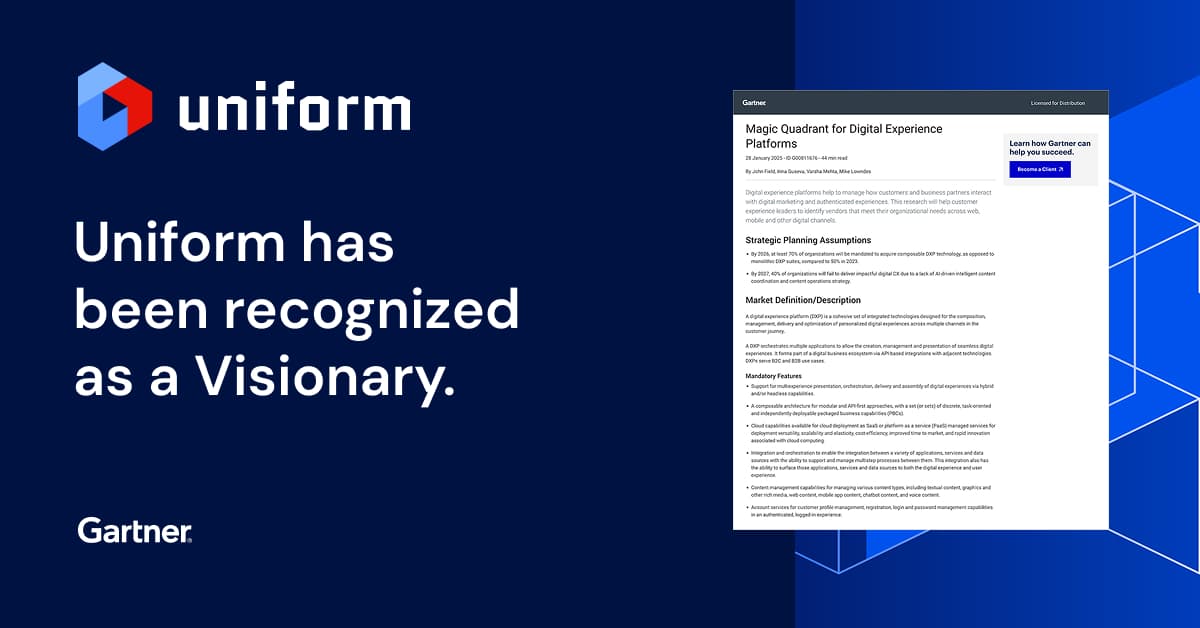
In our view, the term entered the mainstream in May 2026, when Gartner® published its first research note on the category and described a market shift it calls a dual-persona reality: content must now serve human users and AI agents at the same time, because agents increasingly browse, summarize, and transact on people's behalf. Gartner projects that by 2028, 80% of customer interactions will shift from web, search, social, mobile applications, and other traditional digital CX channels to agentic AI interfaces. (Gartner™, Innovation Insight: Agentic CMS, Irina Guseva, Mike Lowndes, 12 May 2026). You can read the full report, courtesy of Uniform.

Get the Gartner™ report

Uniform is named as a Representative Provider in the report. To Uniform, Gartner Representative Providers are illustrative examples of vendors in an emerging market, not an exhaustive list and not an endorsement of any vendor.

TL;DR // 30 seconds

Gartner™ named the agentic CMS category in May 2026 and listed Uniform among six representative providers. An agentic CMS serves humans and AI agents at once through three pillars: automation, decisioning, and orchestration. It scales with compute, not headcount, and you do not need to replace your current CMS to adopt one.

02 // The pillars

The three pillars: automation, decisioning, orchestration

Gartner's report frames agentic CMS around three pillars, and they make a useful map of what actually changes versus a traditional or headless CMS. Described here in our own words.

Automation does the work. Decisioning earns the trust. Orchestration reaches the stack.

  1. 01

    Automation

    The system does content work autonomously: bulk creation and processing, translation and localization at scale, accessibility fixes, and optimization for answer engines (AEO) and generative engines (GEO). The human role shifts from doing the tasks to directing them.

    What to look for: agents that complete whole workflows end to end, not single-step assistants bolted onto an editor.

  2. 02

    Decisioning

    Traditional CMSs depend on humans to push every workflow forward: approvals, compliance checks, governance. An agentic CMS makes many of those calls itself within policies the organization sets, with audit trails recording every autonomous decision so humans can inspect and intervene.

    Decisioning is where trust is won or lost. Agents that act without attributable, reversible decisions do not survive legal review. Look for per-task autonomy controls, not a global switch.

  3. 03

    Orchestration

    Content does not live alone. An agentic CMS coordinates with the systems around it: commerce, CDP, DAM, search, analytics, and other content repositories, using modern protocols such as MCP alongside APIs, and assembles adaptive experiences for both humans and agents at the delivery layer.

    What to look for: whether the agents can reach systems the vendor does not own, including content that lives in another CMS.

"Traditional CMS scales with people. Agentic CMS scales with compute."

Gartner™, Innovation Insight: Agentic CMS, Irina Guseva, Mike Lowndes, 12 May 2026.

03 // Vs headless

Agentic CMS vs headless CMS: what actually changes

Headless was an architectural shift: separating content from presentation so developers could deliver anywhere. Agentic is an operating-model shift: changing who, or what, does the work. A headless CMS still assumes a human operates every step; it just gives that human better APIs.

Headless changed the architecture. Agentic changes who does the work.

How a headless CMS and an agentic CMS differ across audience, content work, governance, structure, delivery, and scaling.
CriterionHeadless CMSAgentic CMS
Built forHuman editors and developersHumans and AI agents, on both sides of the glass
Content workManual, tool by toolRequested outcomes; agents execute, humans approve
GovernanceHuman-driven workflowsPolicy-driven autonomous decisioning with audit trails
StructureTyped entries and APIsTyped entries, semantic layers, and agent protocols (MCP)
DeliveryPages and API payloads for human-facing appsAdaptive experiences consumable by people and agents
Scales withHeadcountCompute

A subtlety worth stating plainly: agentic does not replace structured content, it depends on it. Typed entries, explicit relationships, and clean APIs are the substrate agents need. If you already run a good headless CMS, you are closer to agentic than a team on a legacy monolith.

04 // Use cases

What teams use an agentic CMS for

The practical use cases split into business and engineering work. Gartner's report catalogs both sides; the summary here is ours.

The wins compound: faster operations today, agent-legible content tomorrow.

For marketing and content teams

  1. Autonomous content operations

    Production cycles compress as task-specific agents handle creation, curation, scheduling, and routine approvals, while humans review what ships.

  2. Continuous AEO and GEO optimization

    Agents monitor how content surfaces in AI search and answer engines, then generate and refine variants based on live signals rather than quarterly audits.

  3. Localization at scale

    Translation, metadata, and market-specific variants are handled automatically, rather than moving through outsourcing queues.

For engineering teams

  1. Agent-ready infrastructure

    The CMS exposes content and capabilities through MCP servers, allowing external agents, LLMs, and orchestration platforms to query and act on content directly.

  2. Agentic migration

    Agents audit legacy content, map models, and execute migrations that historically ranked among the most expensive IT projects an enterprise takes on. Social Thinking, for example, migrated off Contentful to Uniform in about three weeks.

  3. AI-assisted development

    Live schemas and content models are available to coding agents and IDE tools, so implementation code is generated against the real content model rather than stale documentation.

05 // The research

Read the research that defined the category.

Gartner® named the category in May 2026 and listed Uniform among six Representative Providers. Complimentary access, courtesy of Uniform.

Gartner, Innovation Insight: Agentic CMS, Irina Guseva, Mike Lowndes, 12 May 2026.

06 // Honest risks

Adoption is early, and the risks are real

Gartner places agentic CMS at the earliest stage of its Hype Cycle, with mainstream productivity five to ten years out, and its report is direct about the adoption hurdles: content and data that are not AI-ready, integration complexity that compounds as agents touch more systems, change management and user trust, and the need for continuous operational governance rather than periodic audits. Two practical implications follow.

Early category, real hurdles. Start small, measure, expand.

  1. 01

    Start small and measure

    The report recommends controlled proofs of concept on low-risk workflows, with continuous evaluation of task completion, intervention frequency, and ROI. That matches how successful teams actually adopt: one contained outcome first, a campaign page or a section migration, then expansion at your own pace. This is why gradual adoption is an evaluation criterion, not a nice-to-have. You should be able to vibecode a project this week, augment your stack this quarter, and evolve over years, without a big-bang replatform.

  2. 02

    Make content AI-ready before scaling agents

    Agents are only as reliable as the structure underneath them. Typed content models, semantic relationships, and clean access protocols come first.

Source for the adoption hurdles and the staged-adoption recommendation: Gartner™, Innovation Insight: Agentic CMS, Irina Guseva, Mike Lowndes, 12 May 2026.

07 // Vendors

The vendor landscape

Most CMS and DXP vendors now use agentic language, and the claims deserve scrutiny against the pillars above. Gartner's report names six representative providers, noting that these are illustrative examples of vendors in the market rather than an exhaustive list or an endorsement.

Six named providers. One question: where can the agents act?

Other established vendors, are also building AI and agent capabilities into their platforms. The useful evaluation question isn't who uses the term, but where each platform's agents can act. Most vendors' agents operate primarily within that vendor's own repository.

Uniform

Scout

Uniform is a best-in-class headless CMS in its own right, and its agent, Scout, executes across whatever stack a team runs, including content living in other CMSs. Scout takes a project from idea to live: content, translation, GEO and AEO optimization, accessibility, and personalization from a prompt, with humans approving what ships.

Companies such as Sainsbury's, Atlassian, and Rituals run Uniform alongside other content platforms.

Agentic CMS or agentic DXP? The terms are related, not rivals. Agentic CMS describes the content layer: how content is created, governed, and made consumable by agents. An agentic DXP spans the full experience: content plus data, personalization, commerce, and delivery, orchestrated across the stack. Uniform delivers the agentic CMS capabilities Gartner describes as part of an agentic DXP.

Read the companion guide: What is an agentic DXP?
08 // FAQ

Frequently asked questions

Short answers to the questions teams ask when they start evaluating the category.

An agentic CMS is a content management system that serves humans and AI agents simultaneously, automating content work, making policy-governed decisions, and orchestrating adaptive experiences, so output scales with compute rather than headcount.

Gartner® Innovation Insight: Agentic CMS (Irina Guseva, Mike Lowndes, 12 May 2026) describes a dual-persona reality in which content serves humans and AI agents, frames the category around automation, decisioning, and orchestration, and projects 80% of customer interactions shifting to agentic AI interfaces by 2028. Uniform offers free report access.

No. AI features help a human operate the tool faster. An agentic CMS changes the operating model: agents execute content work and governance decisions autonomously within policies, humans direct and approve, and content is structured and exposed, including via MCP, so external agents can consume it.

Yes. Uniform is named as a representative provider in Gartner's Innovation Insight: Agentic CMS and delivers agentic CMS capabilities, a headless CMS, and orchestration across existing stacks as part of its agentic DXP, with its agent Scout executing work that humans approve.

No. An orchestration-first platform such as Uniform can sit on top of an existing CMS, letting agents work across content wherever it lives, so teams can adopt agentic capabilities gradually and migrate later, at their own pace, or not at all.

Start with a controlled proof of concept on a low-risk workflow, measure task completion and intervention rates, and make content AI-ready with typed models and a clean structure. Gartner's 2026 report recommends exactly this staged approach, and it maps to launching a first project in hours with an agent like Scout.

09 // Next

The web has two audiences. Build for both.

Agentic CMS is the content layer of the shift. Scout takes a project from idea to live: content, translation, GEO and AEO optimization, accessibility, and personalization from a prompt, with humans approving what ships.

No replatforming required. Start with one project this week.