






.svg)
.jpg)











Roughly 2010 to 2018
Monolithic DXPs
Bundled CMS, personalization, analytics, and commerce into a single suite.
- Solved integration
- Created lock-in. Every capability was only as good as the suite's version of it.
DefinitionAgentic DXP
An agentic DXP is a digital experience platform where AI agents execute real work across content, data, personalization, and delivery, under human direction and approval. Instead of teams operating tools, teams request outcomes: agents build, translate, optimize, and personalize, and humans review what ships.
The web has changed. Digital experiences now serve two audiences: the humans who read them and the AI agents that find, summarize, compare, and transact on their behalf.
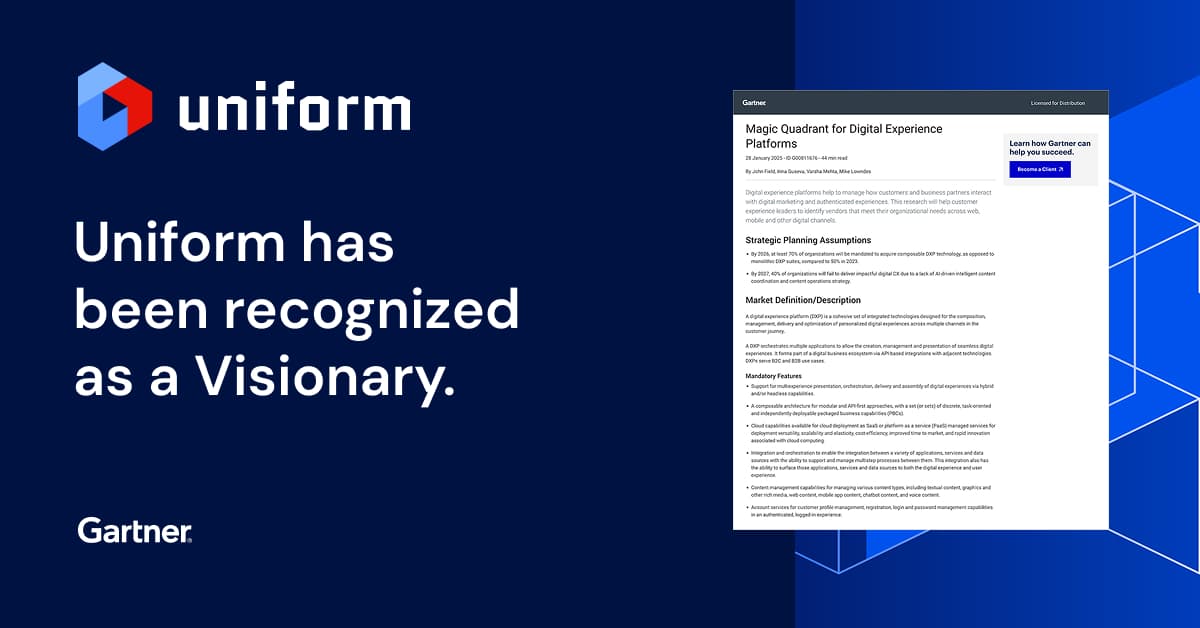
Gartner® projects that by 2028, 80% of customer interactions will shift from web, search, social, mobile applications, and other traditional digital CX channels to agentic AI interfaces. (Gartner, Innovation Insight: Agentic CMS, Irina Guseva, Mike Lowndes, 12 May 2026). An agentic DXP is built for that reality on both sides: agents work inside the platform to produce experiences, and the experiences it delivers are structured so agents outside the platform can consume them.
Get the Gartner reportAn agentic DXP is a platform where AI agents do the work (build, translate, personalize, optimize), and humans approve what ships. It differs from 'AI features' in five capabilities, and the sharpest is whether agents reach your whole stack or only the vendor's own.
Each DXP generation solved the previous generation's bottleneck.
Get the Gartner reportEvery DXP generation removed a bottleneck. This one removes human operating capacity.
Roughly 2010 to 2018
Bundled CMS, personalization, analytics, and commerce into a single suite.
Roughly 2018 to 2024
Unbundled the suite into best-of-breed, API-first services.
Now
Keep the composable foundation and add two things: an orchestration layer that composes the stack into coherent experiences, and AI agents that operate that layer on the team's behalf.
The analyst framing points the same way: The Gartner® 2026 Innovation Insight on Agentic CMS describes this shift at the content layer.
Vendor claims vary widely, so it is more useful to define the category by capability than by label. A DXP is agentic when it has all five of the following. Missing one or two usually means AI features added to an existing platform, which is a different thing.
Agentic is five capabilities, not a label. Missing two means AI features.
An assistant suggests a headline. An agent builds the page, populates it with on-brand content, translates it into your locales, checks accessibility, wires up personalization, and stages it for review.
The test: can a non-technical user request an outcome, such as launching a landing page for the spring campaign in three markets, and receive shippable work rather than advice?
Autonomy without governance is how agentic projects die in legal review. An agentic DXP treats review and approval as part of the agent loop: agents propose, humans approve, and every agent action is attributable and reversible.
Look for configurable autonomy levels by task type, full audit trails, and role-based controls that apply to agents just as they do to people.
Enterprise stacks are heterogeneous: multiple CMSs, a commerce engine, a CDP, a DAM, search, translation. Agents are only as capable as the systems they can reach. A platform whose agents operate only on its own repository automates a silo.
An agentic DXP orchestrates content, data, commerce, and AI from any source, so agents can act across the whole experience. This is the single sharpest differentiator between vendors today.
Agents cannot reliably act on blobs of HTML. They need typed entries, explicit relationships, semantic structure, and clean APIs.
The same structure that lets internal agents build experiences is what lets external agents, such as answer engines and shopping assistants, consume them accurately. Structured content is the shared foundation of both sides of the agentic story.
The output of an agentic DXP has to serve humans with fast, accessible, personalized pages, and agents with semantic markup, feeds, and protocol surfaces such as MCP that let AI systems query content directly.
If a platform's agentic story ends at authoring and says nothing about how agents consume what it delivers, it is half a story.
Three architectures that are often described with the same vocabulary, separated by who operates the tools and how far the agents reach.
| Criterion | Composable DXP | DXP with AI features | Agentic DXP |
|---|---|---|---|
| Who operates the tools | Humans | Humans, with AI suggestions | Agents, with human approval |
| Unit of work | Tasks and tickets | Faster tasks | Requested outcomes |
| Scope of AI | None or bolt-on | The vendor's own repository | The whole stack, any source |
| Content model | Structured | Structured | Structured and agent-consumable (APIs, MCP) |
| Audience served | Humans | Humans | Humans and agents |
| Scales with | Headcount | Headcount, slightly less | Compute |
Most established DXP and CMS vendors now use agentic language, yet the approaches differ in ways that matter for evaluation.
The evaluation question is scope: the vendor's box, or your whole stack.
Stream
Positions around an AI layer that powers brand-aware generation and task automation inside its platform.
Agentic Experience Platform
Has repositioned around agents woven into its own stack.
AI assistance
Embeds AI assistance and personalization into authoring and delivery.
Opal
Centers its agentic story on an AI layer across its marketing operating system.
The common pattern: each vendor's agents primarily operate on that vendor's own products. That is a coherent strategy, and for teams standardized on one suite, it may be sufficient. The open question to ask in any evaluation is what happens to the rest of the stack.
Most enterprises run multiple content systems alongside commerce, CDP, and DAM platforms, and agents that stop at the vendor boundary leave most of the experience unautomated.
Takes the orchestration-first approach: a best-in-class headless CMS in its own right, with an agent that executes across whatever stack a team runs, including content living in other CMSs.
Companies such as Sainsbury's, Atlassian, and Rituals run Uniform alongside other content platforms rather than replacing them. Scout takes a project from idea to live: content, translation, GEO and AEO optimization, accessibility, and personalization from a prompt, with humans approving what ships.
Take these into vendor conversations. Each one separates a platform where agents do the work from a platform where AI writes suggestions.
Seven questions separate agents that work from AI that suggests.
Ask for a live demo of an outcome request, not a feature tour.
Look for per-task autonomy controls and complete audit trails, not a global on/off switch.
List your systems of record and ask, for each one, whether the agent can read from and act on it.
Typed entries, explicit relationships, versioning, and clean APIs. If content is stored as page blobs, agents will be unreliable.
Ask about semantic delivery, structured data, and MCP or equivalent protocol support.
You should be able to start with one project this week, augment an existing stack this quarter, and evolve gradually, without a big-bang migration. Half-measures are a feature, not a compromise.
If value scales with seats, you are buying a tool. If output scales with computations under a predictable model, you are buying capacity.
Independent analysts note that the main constraint on agentic adoption is organizational readiness and governance, not technology. This supports platforms that enable gradual adoption and human approval and argues against big-bang replatforming in either direction.
Short answers to the questions teams ask when they start evaluating the category.
An agentic DXP is a digital experience platform where AI agents execute real work across content, data, personalization, and delivery on a team's behalf, with humans setting outcomes and approving what ships.
An agentic CMS applies agents specifically to content management: creating, structuring, and maintaining content. An agentic DXP is broader: it spans content plus data, personalization, commerce, and delivery, orchestrating the full experience across the stack.
No. AI features assist a human who operates the tool, and usually only within one vendor's repository. An agentic DXP inverts the model: agents operate the platform across the whole stack, humans direct and approve, and output scales with compute rather than headcount.
No. Agents remove the tool-operating work: building pages, translating, optimizing, wiring personalization. Humans keep strategy, brand judgment, and final approval of everything that ships, and developers shift from ticket queues to product work.
Uniform, Sitecore, Contentstack, Contentful, and Optimizely all offer agentic capabilities with different architectures. The key evaluation difference is scope: whether agents operate only within the vendor's own products or orchestrate work across any stack, including existing CMSs.
Start with one contained outcome, such as a campaign page or a section migration, and expand from there. Uniform, for example, supports launching a project in hours with Scout, augmenting an existing stack over a quarter, or migrating gradually over time.
Start with one contained outcome and expand from there. Scout takes a project from idea to live: content, translation, GEO and AEO optimization, accessibility, and personalization from a prompt, with humans approving what ships.
No replatforming required. Start with one project this week.
Continue the series
What is an agentic CMS?
The same shift at the content layer, and the capabilities that define it.
How to make content AI-ready
How to structure content so agents can find, parse, and cite it.
MCP for content management
How agent platforms reach your content operations, and what to govern.
Speed to market in 2026
Why handoffs between teams, not tooling, set your release pace.