EBOOK

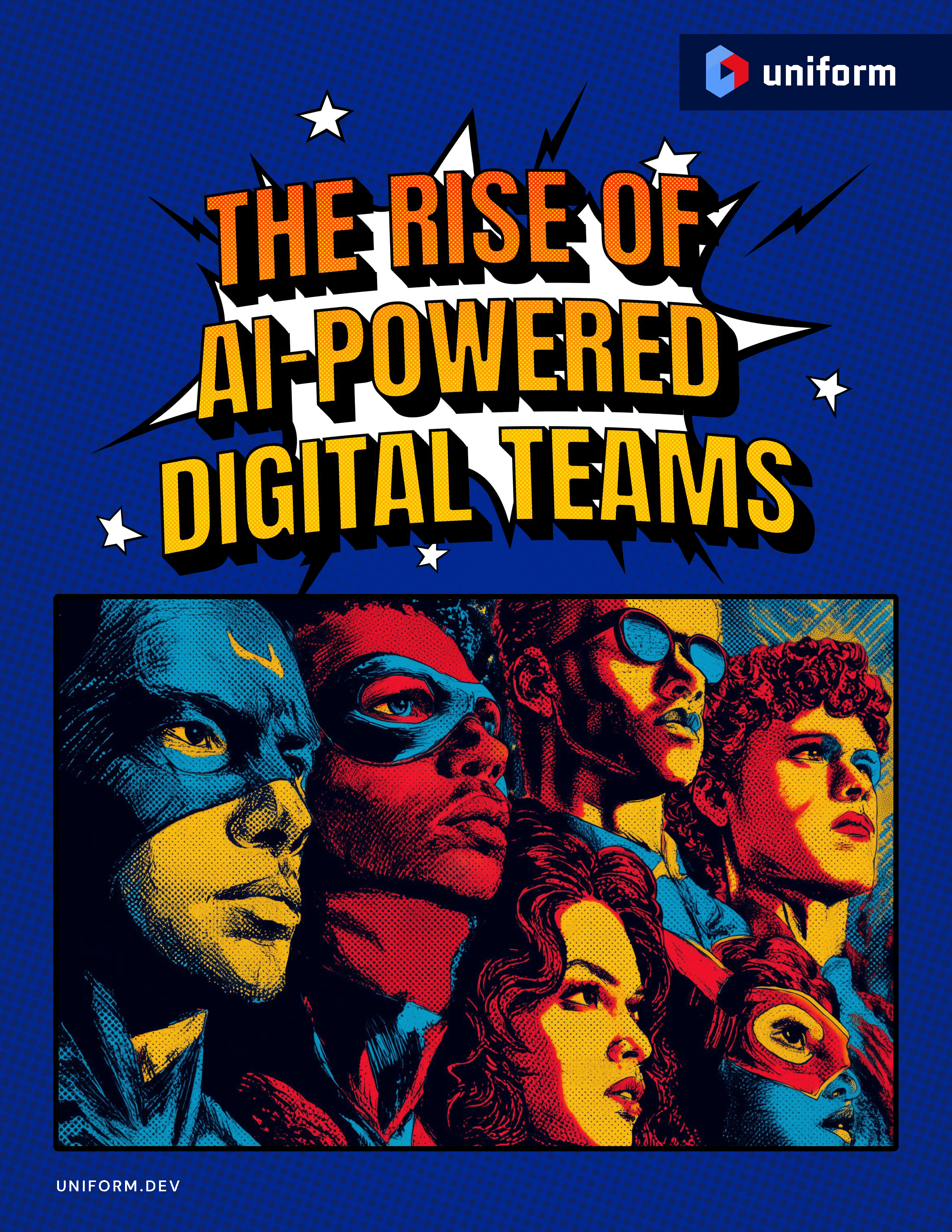
The rise of AI-powered digital teams

Achieve more with less across the digital experience workload

INTRODUCTION

In the age of artificial intelligence (AI), where fast, personalized experiences are vital for earning attention, can marketing and development teams become the “digital heroes” they strive to be in their organizations?

Just as comic book heroes depend on super-genius and otherworldly tools to amplify human abilities, generative AI (gen AI) and agentic AI enable humans to perform tasks previously thought impossible just a few years ago.
When AI is fully integrated into composable platforms, marketers gain the power to automate manual processes and remove technical gridlock, enabling them to do their jobs more quickly and efficiently than through traditional methods.
Much like the coveted powers that allow fictional heroes to achieve amazing feats, marketers in real-world businesses are discovering that AI and composable architecture are a mighty duo for accelerating and optimizing digital experiences.
In this guide, we examine how AI helps marketers and developers supercharge and reinvent their digital workflows, from increasing productivity to decreasing migration time to improving personalized experiences.
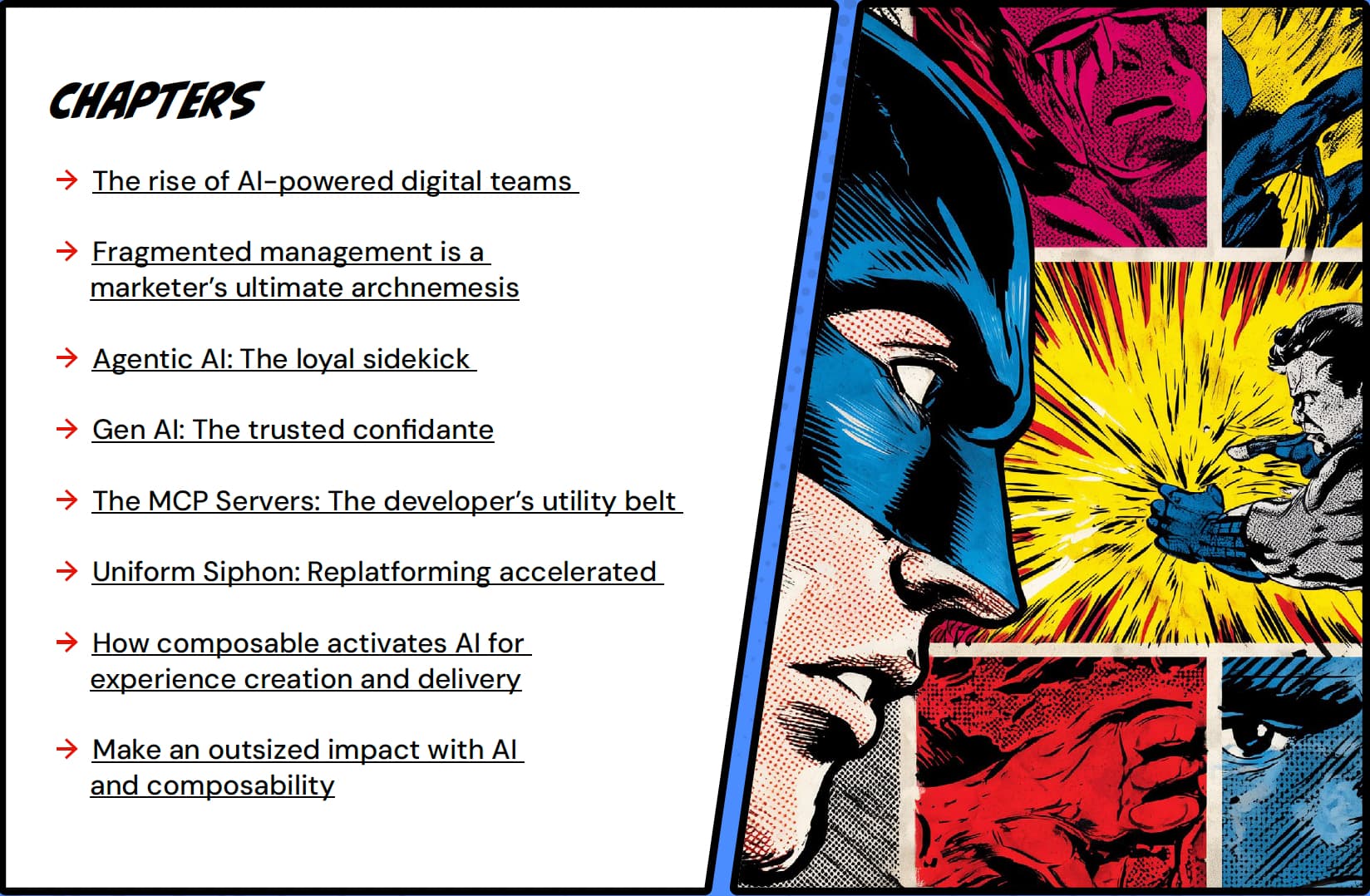
Chapters on AI-powered digital teams
Pop art superhero portrait

The rise of AI-powered digital teams 

The life of an enterprise marketer isn’t slowing down anytime soon. Outdated legacy systems underpinning internal and development processes can slow the creation and delivery of experiences to a snail’s pace.
Compounding this sentiment is AI, which has solidified expectations that any marketing team can execute stellar campaigns on budget and on deadline. Furthermore, digital experiences must meet constantly changing customer expectations. Brands must deliver fast, consistent experiences across channels, whether shopping on apps or submitting leads on mobile.
As AI reshapes industries weekly, the technology is turbocharging marketing productivity. For example, More than three-quarters of respondents to a McKinsey study say their organizations use AI, particularly gen AI, in at least one business function. 

AI alone isn’t a superpower; however, as deep-learning models operate without fatigue or a cognitive ceiling, human abilities will be amplified well beyond known limitations.

Similar to fictional superheroes who wear armor suits and wield sophisticated gadgets to battle evil, modern marketers increasingly turn to AI to blast through everyday obstacles on the job. And while resource gaps and production delays might appear routine on the surface, they can quickly snowball into major challenges that threaten a company's ability to remain competitive and sustain revenue. 

THE CHALLENGE

Fragmented management is a marketer’s ultimate archnemesis

Medium- and large-sized enterprises contend daily with disconnected systems that create coordination overhead. Users spend significant time navigating multiple tools, including external AI services, resulting in manual, cross-platform work to maintain brand voice, design standards, and legal compliance.

Studiorover a full body shot of this villian with an explosion
This fragmentation, combined with traditional technology stacks that fail to keep pace with AI-driven demands, is a foe that stifles even the most talented and well-equipped teams. By 2027, 40% of organizations will fail to deliver impactful digital experiences due to a lack of AI-driven intelligent content coordination and content operations strategy. 
Outdated legacy systems and a lack of coordination among teams, workflows, and systems stand in the way of AI’s claim to deliver greater speed and better customer outcomes in campaigns. 
However, with a composable platform that emphasizes visual building and API-first system integrations, marketers can harness the power of AI to experiment at minimal risk and cost, leverage AI capabilities without high-priced migrations, and build personalized experiences independently. 
Marketers can be the digital heroes their companies need. They simply need the right digital architecture and integrated AI to reach their goals. 
Studiorover: A superhero villain about to destroy a city
Comic book heroes with ray gun

AI TYPES

Gen AI. Agentic AI. What’s the difference?

A quick rundown of each and how AI tools push the boundaries of what’s possible in digital experience management.

Generative AI
Generative AI creates new content (e.g., text, images, audio, video, etc.) by identifying and synthesizing learning patterns and relationships from extensive amounts of data in real time. Gen AI requires human prompts to initiate and generate a single, comprehensive output, whether it’s a landing page or a hero image. According to Gartner, over 80 percent of organizations will have deployed gen AI applications or used gen AI application programming interfaces (APIs) by 2026.
Agentic AI
Generally, agentic AI is a more advanced form of artificial intelligence that uses natural-language requests to operate and execute through conversation. Agentic AI contextualizes its actions based on existing content and data, enabling it to handle complex tasks with human oversight. Additionally, AI agents in composable environments can interact with external systems and databases, run A/B tests, implement personalization, and process analytical outcomes, making them ideal tools for SEO (search engine optimization), AEO (answer engine optimization), GEO (generative engine optimization), and CRO (conversion rate optimization).

By 2027, 40% of organizations will fail to deliver impactful digital CX due to a lack of AI-driven intelligent content coordination and content operations strategy.

AGENTIC AI

Agentic AI: The loyal sidekick

Like all great teammates, agentic AI provides technical expertise, supports execution, and extends a user’s reach by identifying areas for improvement, streamlining processes, and reducing repetitive work.

Studiorover a female superhero saving a civilian retro comic book

Think of agentic AI like a superhero’s sidekick, jumping into action at a moment's notice, adaptable across any environment or situation, augmenting and amplifying human strengths, and delivering impact when and where it's needed most.

The tireless colleague

Uniform’s Scout is an example of an agentic AI teammate, designed to help human counterparts create, optimize, and deliver experiences at record speed. Scout is a content creator, strategist, translator, and analyst, all wrapped into one, built for around-the-clock support. 
Using natural language commands and contextual intelligence, Scout:
  • Reduces migration complexity: Agentic AI fast-tracks large replatforming projects and AI adoption by effectively cleaning, scanning, and standardizing data. 
  • Accelerates time to launch. A composable platform’s AI agent accepts work on prototyping AI platforms, such as v0 and Cursor, as well as design tools like Figma, translating the generated designs and development into functional web components ready for deployment.
Additionally, agentic AI:
  • Translates content in any language while preserving the brand voice and tone. This reduces the time to localize content for multiple regions from weeks to hours.
  • Creates A/B test variants, configures personalization from real-time customer data, and executes changes within role-based approval workflows.
  • Auto-tags content to improve searchability and addresses accessibility issues without waiting for IT tickets.
Native AI agents like Scout enable marketers to experiment with innovations they would not have time for if built by hand. They allow creative teams to execute previously manual tasks across the entire digital experience platform (DXP) by cultivating components using content and data from every source in the architecture through a single interface, with a sole agent that can implement the entire plan in seconds. 
In today’s digital age, time is one of marketers’ most critical assets. AI agents put their powers to work, updating content, creating front-end components from vibecoding, and configuring personalization rules so that human marketers can focus on launching winning campaigns on time.

Gen AI can potentially boost marketing productivity by 5 to 15 percent of total marketing spend, totaling $463 billion annually.

Studiorover a female superhero sidekick rescuing a kitten from
Studiorover a retro superhero butler, the butler should be clean

GENERATIVE AI

Gen AI: The trusted confidante

Gen AI helps marketers swiftly brainstorm ideas, produce compelling visuals, or write error-free text in seconds, versus spending hours or days to complete the same work manually. The work of a large creative team is squeezed into a browser tab that renders in seconds.

Think of gen AI as the trusted caretaker of a superhero (and their alter ego). Part aide-de-camp, part butler, and meticulous in its production, gen AI always has an answer on hand and is adept at keeping assignments organized and on track.

The potential of gen AI to boost marketing efficiency grows exponentially when integrated into company-wide processes and workflows. For example, tailoring content for different audience segments across multiple web pages is not only possible; it's also effective, delivering targeted results in record time. 

Gen AI gives users the power of a full team

One of the benefits of a truly composable platform like Uniform is the Visual Workspace, an intuitive environment that enables marketers to compose digital experiences using content from any system or AI service in the tech stack. The ability to scale efforts exponentially is a game-changer for smaller teams that rely on efficiency to perform work equivalent to teams twice their size. 
As companies move from experimenting with gen AI to demonstrating measurable results, the technology has proven it can be a differentiator in driving campaigns: Marketers report being 44 percent more productive and saving 11 hours per week with AI. 
When it comes to delivering speedy personalized experiences, AI tools are helping digital teams demonstrate marketing ROI by:
  1. Automating content creation: Marketers can use gen AI to rapidly produce copy, images, video, audio, and other content from prompts, drastically reducing the time and effort required to draft blogs or design images manually. 
  2. Streamlining workflows and reducing IT dependencies: By enabling marketers to create and blend governed AI-generated content directly into components, the work bypasses developer backlogs that typically slow content delivery and approval. 
  3. Enabling hyper-personalization at scale: Composable DXPs integrate gen AI throughout the digital production process. Marketers can leverage customer data and business intelligence through the lens of corporate guidelines to launch personalized campaigns for specific audience segments across numerous platforms and devices.
From startups to global corporations, gen AI can serve as a virtual assistant (with human oversight and preset prompts) to teams tasked with producing large volumes of content and launching speedy campaigns. Compressing production time makes marketers more effective, allowing them to do more with less.
The expeditious generation of campaign assets increases speed to market and frees up capacity to focus on more strategic initiatives—a win for brands and digital teams. 

The expeditious generation of campaign assets increases speed to market and frees up capacity to focus on more strategic initiatives, a win for brands and digital teams.

Pop art portraits of a distinguished gentleman

MCP SERVERS

The MCP Servers: The developer’s utility belt

The productivity gains AI gives marketers are just part of the full picture of what AI makes possible within a composable DXP. The same technologies that enable a small marketing team to perform like a full department also help developers compress some of the most expensive, time-consuming work in the digital experience lifecycle. AI’s impact shifts from boosting productivity to reducing risk and accelerating migration timelines.

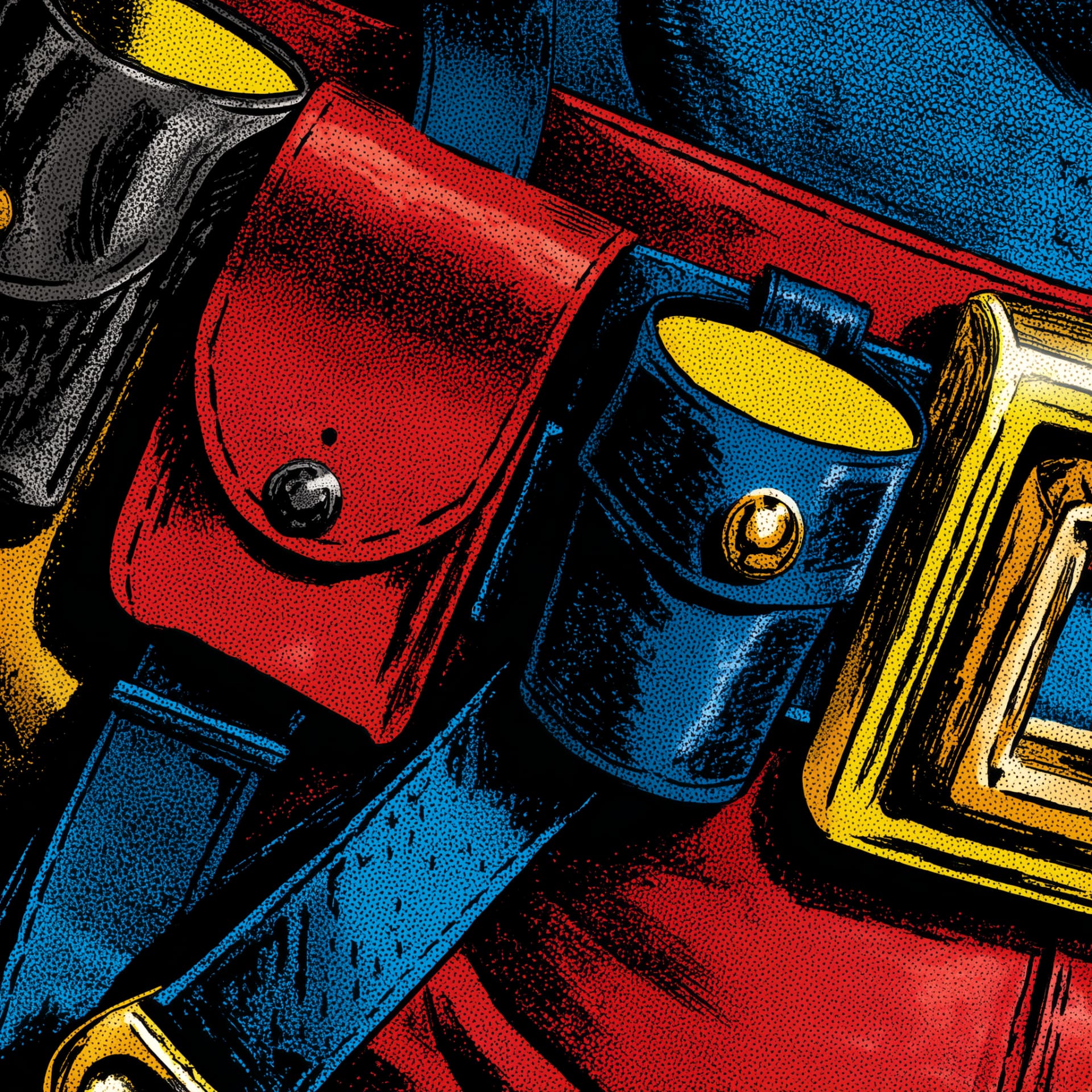
Studiorover extreme close-up of a superhero utility belt retro
MCP servers enable development teams to drastically reduce the time required for lengthy frontend rebuilds and migrations by expediting both development work and implementation into a DXP. 

Think of an MCP Server like a superhero’s utility belt, accelerating the mission and offering limitless options to combat failures that plague manual migration projects.

For example, Uniform’s MCP Server connects directly with AI tools like Claude, Cursor, or GitHub Copilot, providing users a multitude of specialized tools to accomplish their goals. Some examples:
  • Bruce has existing components in his codebase that he wants to bring into Uniform.
  • Tony is building net-new components and wants to work code-first with AI assistance.
  • Alfred needs to manage operations at scale (e.g., bulk updates, creating multiple pages from templates, etc.).
A simple prompt, such as "Create a hero component with a headline, subheading, CTA, and background image", generates the component to fit perfectly inside of a Uniform project.
Moreover, this integration connects seamlessly with existing martech investments, including CMSs, digital asset management systems (DAMs), customer data platforms, commerce engines, and more. 
When composable DXPs enable AI to operate at every layer of the platform, developers can keep the business at the forefront of innovation while marketers push the company past the competition at the speed the market dictates.
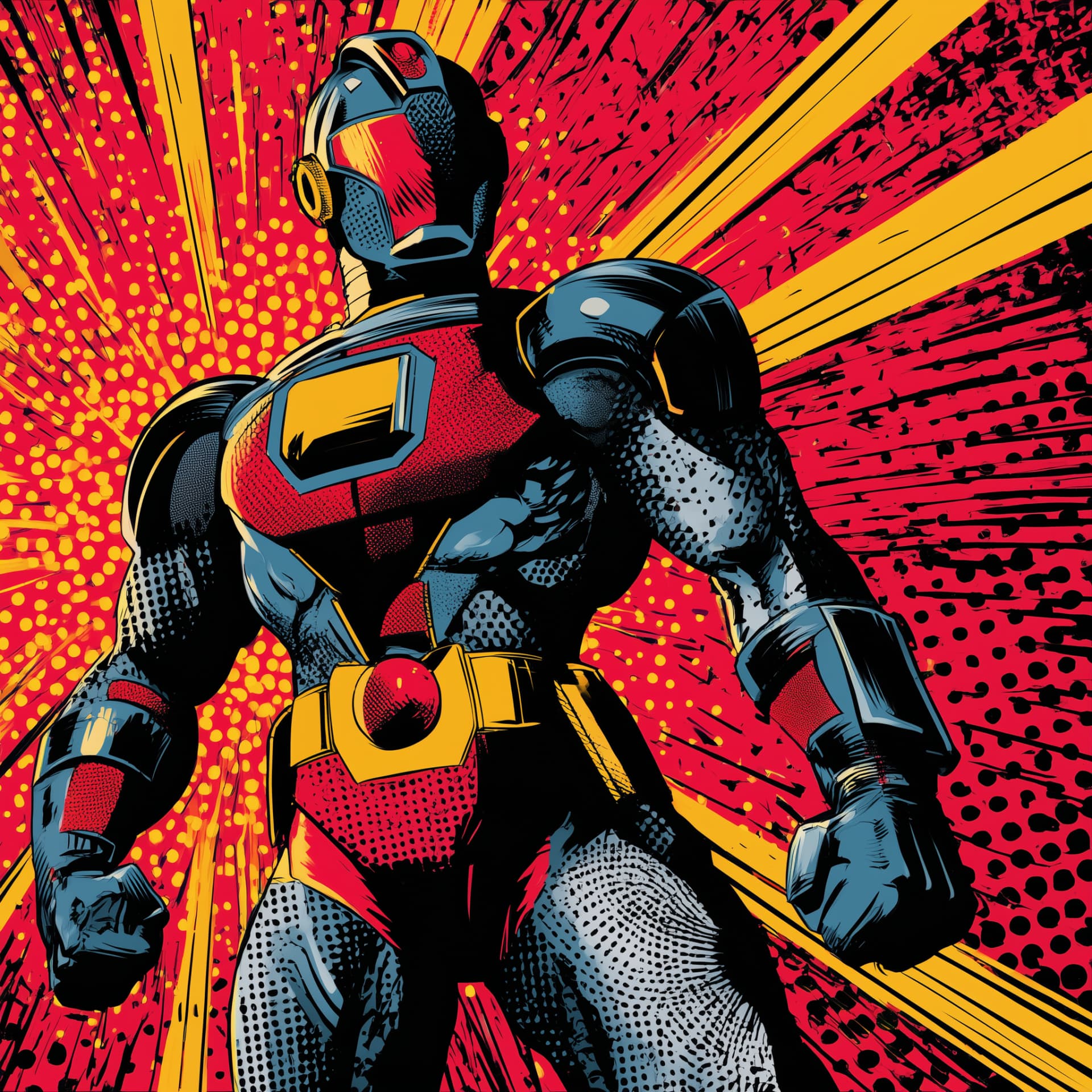
Untitled design (15)
Studiorover: A full body shot of a superhero with an armored suit

SIPHON

Uniform Siphon: Replatforming accelerated

While AI is popular for automating marketing tasks, developers can tap into one of AI’s big strengths: automating the migration process.

AI can make replatforming easier, faster, and less costly, enabling digital teams to incrementally migrate their legacy systems on a timeline that works best for their business and budget. For example, Uniform Siphon is a proprietary tool that automates AI-powered front-end migration, reconstructing existing websites without access to the code, inside Uniform in minutes.

Think of Siphon like a superhero’s armored suit—endowing its owner with the strength and speed to accomplish feats that normally take a tremendous amount of hours, labor, and costs.

Digital teams can rapidly rebuild websites on composable DXPs like Uniform without access to source code, expediting front-end migration. This provides business leaders with several key advantages:
  • Significant time and budget savings: AI-powered migrations reduce CMS migrations from several months to weeks or even a few days to configure.
  • Fewer risks: Many organizations are loath to overhaul their CMS due to potential downtime. Modern composable platforms enable digital teams to move from concept to live experience while minimizing content freezes and reducing downtime.
  • Fast, automated digital production processes: AI-driven migration tools drastically reduce the manual work associated with traditional migrations, minimizing human error and shortening timelines.
  • A modern, composable framework: Composability enables the clean, sustainable separation of front-end presentation from back-end data systems, providing a flexible, scalable, future-proof foundation.
By eliminating manual content mapping, data cleaning, and component rebuilding, an AI tool like Uniform Siphon reduces the cost, time, and complexity of moving data between systems and applications, thereby eliminating technical debt and enabling future-proof capabilities. 
Comic book scene of disaster and hope

How composable activates AI for experience creation and delivery

Every hero and heroine, real or imaginary, has an origin story. The Herculean effort to overcome obstacles so great that they define the protagonist's purpose and lead to incredible achievements that transcend known limits and expectations.
The digital production processes that drive customer experiences are not so different. They’re often the product of extensive ideation, planning, and execution, and seamless coordination across numerous stakeholders, departments, and platforms, all working towards one goal: driving revenue.
For marketers, momentum is often lost during campaign building. Digital teams can fail to move from the point of origin (i.e., the brainstorming and ideation phase) to execution and continual optimization. As a result, marketers struggle to close the gap between prototyping an idea and deploying omnichannel campaigns on time.
Moreover, the gap between using AI technologies for individual use cases and permanently embedding them into daily workflows remains a challenge for marketing and IT leaders. Digital teams quickly discover that integrating AI into their content delivery infrastructure requires integration with their existing stack and connected systems that work seamlessly together, not to mention oversight and governance. 
The lack of supporting infrastructure can be a major barrier for organizations. For example, 51 percent of organizations report having cloud-based technology for agentic AI, compared to 89 percent for gen AI. Moreover, only 47 percent of brands state they’re using gen AI or agentic AI to design customer journeys or activate omnichannel campaigns.
Masked superhero flying above the city

Composable moves teams from AI-hesitant to AI-first experiences

To overcome the activation barrier, more enterprises are shifting to composable DXPs. Yet, it’s estimated that around 30 percent have yet to switch to modern front-end architectures. 
This means the majority of organizations face the dilemma of undertaking an expensive replatforming to access AI-powered personalization and experimentation, or risk falling behind competitors in the race to launch fast, compelling experiences.
Digital teams need an integration framework that removes silos, simplifies governance and personalization, and accelerates time-to-market. 
With tools like Siphon and the MCP server available now, there is no better time to modernize an architecture, future-proof existing investments, and lay a foundation that scales with integrated AI.
A truly composable platform will provide teams unified access to all external sources, leveraging AI at every layer of content production and delivery to enable users to create and publish experiences faster than other DXPs.
Composable platforms, such as Uniform, enable teams to adopt AI and enhance digital workflows under budget with minimal risk. Ground-up composability that helps marketers:
  • Avoid duplicate work and enforce brand consistency across sites and locales. Built-in AI accelerates the reuse of branded, approved components and content types across all webpages and channels.
  • Build contextual experiences within boundaries and corporate guardrails that the team controls. AI tools generate content in line with a company’s style guide and visual standards, reducing human interpretation and error. 
  • Effortlessly blend AI-powered content with content from external platforms. Marketers can lean on gen AI and agentic AI to rapidly create, test, and optimize experiences, tailoring them to specific locales, audience segments, and customer behaviors inside a single, visual UI.
A composable-first platform delivers more than bolted-on AI capabilities. Composable DXPs like Uniform lay the architectural foundation for AI to work throughout experience management, from content generation to optimization, across pages and locales. With this power, marketers can move from idea to production to execution in a fraction of the time it would take with other platforms.
Being a digital hero in an organization doesn’t require perfection or a complete digital transformation. Teams simply need the right tools to make quick edits that support rapid prototyping and fast deployment.


How Uniform’s composable platform facilitates AI activation

  • 70+ pre-built integrations make content from any system accessible for AI orchestration— no prior API project required.
  • Digital teams can work with AI at every layer of the platform.
  • Leverage production-ready components from prompts or design files in just a few seconds.
Colorful comic book superhero team

Make an outsized impact with AI and composability

Uniform, a composable platform equipped with built–in integrations and native AI capabilities, enables marketing teams to be their company’s champion by fast-tracking the path from production to deployment to optimization. Its flexible, modular foundation leverages AI’s revolutionary cognitive capabilities to help marketers deliver personalized experiences on budget and on time. 
A composable platform with native AI capabilities accelerates learning cycles, iteration, and content delivery. 
Integrated AI systems automate repetitive but critical tasks, including visual editing, content optimization, personalization, and A/B testing. They also accelerate complex replatforming projects, helping digital teams replatform aging CMSs and shorten migration timelines by months. 
Removing crucial bottlenecks caused by broken workflows, organizational silos, and rigid architectures allows brands to increase marketing velocity, empower digital teams to boost content creation and deploy changes in response to market demands without costly delays or unnecessary front-end migrations. 
Uniform’s composable, AI-powered technology equips marketers with visual tools to push beyond traditional limits at scale, to become digital champions capable of increasing revenue through speed and untapped innovation.

Being a digital hero in an organization doesn't require perfection or a complete digital transformation. Teams simply need the right tools to make quick edits that support rapid prototyping and fast deployment.

CLOSING

The rise of AI-powered digital teams

Being a digital hero in an organization doesn't require perfection or a complete digital transformation. Teams simply need the right tools to make quick edits that support rapid prototyping and fast deployment.

Silhouette overlooking the city

Download the PDF

AI_Heroes-ebook-202604-1_Page_01.png