






.svg)

.jpg)













Uniform blog/Cracking the cold start puzzle: The hidden challenge in digital experiences
Cracking the cold start puzzle: The hidden challenge in digital experiences
.png&w=256&q=75)
Cracking the cold start puzzle: The hidden challenge in digital experiences
TL;DR
Explores the 'cold start' challenge in digital experience platforms (DXPs), where lengthy implementations delay campaign launches and ROI. AI-native architecture like Uniform’s eliminates these bottlenecks by enabling rapid integration, instant optimization, and marketer autonomy. The key takeaway: organizations that prioritize implementation velocity with AI-native DXPs gain a decisive competitive edge by launching campaigns in days, not months.
Marketing leaders authorize investments in digital experience platforms to accelerate campaign delivery and eliminate coordination bottlenecks. What really happens? Seasonal campaigns miss their launch windows during extended setup periods. Competitive responses arrive late. Budget cycles expire before the platform demonstrates any return on investment. The tool or platform purchased to accelerate delivery becomes the primary obstacle to launch.
The marketing organizations winning this game compress implementation cycles from quarters to days. That velocity difference determines who launches campaigns while competitors sit in planning meetings.
Why vendor demonstrations focus on post-launch capabilities
The pattern is all too familiar in many DXP vendor demos: AI generates headline variations, assembles content alternatives, configures A/B tests. Everything assumes the platform already runs in production. Workflows exist. Integrations work. Governance structures operate. Marketing teams show up ready to optimize.
Then reality hits. Those optimization features sit locked behind months of expensive implementation work. The platform exists, but nobody can use it.
Most vendors bolt AI features onto existing workflows, enhancing post-launch operations without addressing the architectural constraints that create implementation delays. AI-native platforms take a fundamentally different approach, integrating intelligence at every architectural layer from inception to eliminate coordination bottlenecks throughout implementation, not just after launch.
Market timing matters more than budget management in this case. Competitors do not wait for implementation cycles to finish. Every delayed launch hands them market presence and customer relationships. The advantage compounds while organizations wrestle with configuration.
Three failure modes show up repeatedly:
- Marketing builds prototypes in modern tools, then discovers production requires complete platform reconstruction and developer coordination to deploy anything.
- Design concepts move through collaborative reviews, then wait in queues for technical implementation sprints that stretch across quarters.
- Legacy systems need modern capabilities, but face migration timelines that would shut down operations for months.
Architectural constraints preventing cold start solutions
Traditional DXP architectures expect consultant-led implementations, extended configuration periods, and sequential deployment phases. Vendors designed platforms assuming that organizations would accept multi-year commitments and gradual capability adoption. AI features added to these architectures enhance existing workflows but cannot fundamentally change how organizations initiate projects.
Market research indicates that integration complexity with legacy systems remains the top barrier to DXP implementation, potentially adding up to 30% to project costs and delaying time-to-value. The bottleneck exists at architectural levels. Integration complexity creates severe constraints, as each martech connection becomes its own project with its own dependencies, timelines, and coordination overhead.
Composable architectures promise flexibility but often deliver integration complexity when components require custom API development, separate authentication flows, and ongoing maintenance coordination. Organizations discover that best-of-breed component selection creates integration paralysis rather than operational flexibility.
Uniform's architectural approach to cold start elimination
Uniform solves the integration paralysis that plagues traditional composable approaches by building cold start elimination into the platform architecture from day one. The platform ships with 70+ pre-built connections to content systems, digital asset managers, customer data platforms, commerce engines, and analytics tools.
Teams configure connections instead of writing custom integration code. More importantly, Uniform operates as an AI-native platform, where intelligence is integrated throughout the entire system architecture, not just in the content optimization layer, where most vendors typically bolt it on.
The platform provides four interconnected capabilities that directly counter the common implementation failure modes:
- MCP Server connects AI assistants to Uniform entity management via 21 tools, enabling natural-language prompts to generate production-ready components. Developers transform prototypes from tools like v0, Lovable, or Figma into managed systems without manual reconstruction.
- EditMySite enables organizations with existing websites to gain instant optimization capabilities without migration projects. Organizations input URLs and immediately access personalization, experimentation, and analytics capabilities.
- Siphon completes migrations in hours to days rather than quarters when strategic replacement becomes necessary.
- Scout serves as a persistent AI partner beyond initial launch, creating, optimizing, and personalizing experiences without manual coordination.
Implementation velocity demonstrated through customer outcomes
Canadian telecommunications organization TELUS realized $1.1 million ROI through Uniform implementation, with a 60-fold increase in developer efficiency and 50% improvement in speed to market. The efficiency transformation illustrates architectural impact: developers previously consumed by manual integration work redirect focus toward innovation and differentiation.
TELUS faced siloed experience management with fractured teams and disconnected content management systems, resulting in high operational costs and inconsistent customer experiences. Development teams duplicated UI components across projects. Marketing teams heavily relied on developers to publish changes, resulting in delays in campaign velocity.
By adopting Uniform's MACH-based architecture with pre-built integrations, TELUS unified its content management and activated its design system. Marketers gained autonomy to create and manage reusable UI components, which dramatically reduced developer dependency and enabled more agile workflows.
Evaluation criteria for platform selection
Organizations evaluating digital experience platforms should prioritize cold start metrics above feature capability comparisons. Traditional evaluation frameworks examine optimization sophistication, personalization depth, and analytics capabilities. Those features matter only after platforms become operational and accessible to teams.
Cold start evaluation criteria:
- Time from concept to first production deployment: Organizations should measure implementation cycles in days rather than months
- Ability to optimize existing experiences without migration: Determines adoption barriers and progressive enhancement viability
- Migration timeline when replacement becomes strategically necessary: Determines transition risk and operational continuity
- Developer dependency for marketing execution: Determines operational autonomy and competitive responsiveness
- Personalization launch requirements: Organizations cannot afford personalization engines remaining dormant for months while collecting behavioral data
Cold start represents competitive positioning rather than a technical challenge. Organizations addressing cold-start issues launch campaigns, while competitors schedule implementation approaches. Velocity advantages compound continuously because successful launches enable faster subsequent launches through established infrastructure and organizational capability.
The competitive imperative
The era of accepting extended platform implementations as inevitable digital transformation is over. Organizations that still accept implementation paralysis as unavoidable often discover that competitors no longer do.
AI-native architectures designed with cold start elimination as a primary objective fundamentally change organizational capabilities. The question shifts from whether cold start solutions exist to whether organizations can afford to operate without them. Implementation velocity increasingly determines market leadership as organizations compress cycles between strategic decisions and operational execution.
Stop treating long implementations as “the cost of doing business.” See how Uniform’s AI‑native DXP eliminates cold start delays so your next campaign launches in days, not quarters—book a tailored demo and turn your digital experience backlog into live experiences now.
FAQs
Each martech connection requires API development, authentication flows, and maintenance coordination. Best-of-breed selection creates coordination paralysis when every component requires separate integration projects with dependencies and timelines.

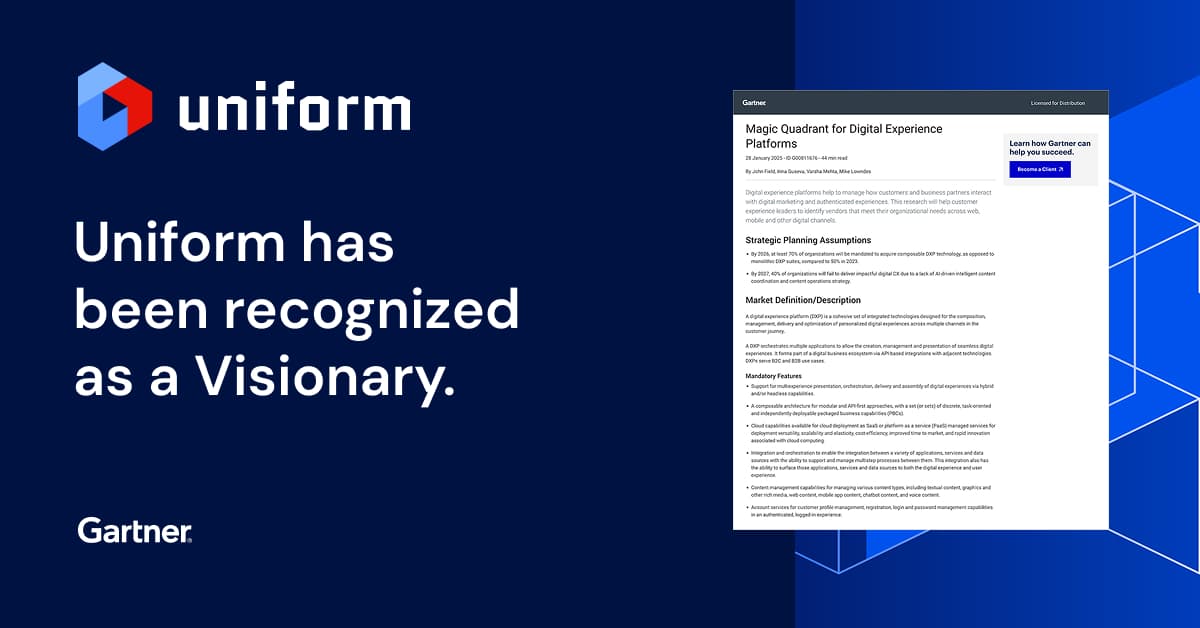
Uniform Recognized as a Visionary in 2025 Gartner® Magic Quadrant™ for Digital Experience Platforms
Learn More