






.svg)

.jpg)













Uniform blog/What slows marketers down?
What slows marketers down?

What slows marketers down?
TL;DR
The largest obstacles slowing marketers include reliance on developers, disjointed AI tools, and siloed personalization efforts. Having a modern composable digital experience platform (DXP) matters–how integrated AI, streamlined workflows, and unified data empower teams to deliver faster, more personalized experiences. The key takeaway: composable DXPs are the catalyst for marketing agility and autonomy in a rapidly evolving digital landscape.
AI is transforming enterprise marketing across all industries, creating new opportunities to deliver data-driven, personalized experiences. As AI adoption accelerates, so does the need to produce faster, more scalable content across channels. And while vendors promise modern platforms that convert at record speed, enterprise marketers continue to face barriers when moving digital experiences from production to deployment.
What’s standing in the way of marketing efficiency and rapid experience delivery? Let’s examine three major obstacles and how a composable digital experience platform (DXP) helps marketers overcome them with cutting-edge capabilities, from integrated AI to real-time personalization.
Obstacle 1: Unending reliance on development resources
Despite brand and digital teams’ increased need for speed, studies show that “85 percent of effort and cost in a DXP program will be spent on integrations with internal and external systems, including the DXP's own, built-in capabilities.” For marketers creating campaigns to respond to market demand, this means navigating a go-to-market architecture that relies on custom code and extensive developer support to do the bare minimum.
Instead of moving smoothly from conception to production, marketers must submit IT tickets for developers to:
- Build components that use data and content sourced from outside the CMS
- Publish pages, as markets lack either access or coding skills
- Update content and components, from minor edits to complete duplication with variation
- Transcribe copy from documents and spreadsheets into elements manually
- Integrate and update external tools with the necessary custom code
A composable DXP minimizes the need for bespoke development, enabling creatives to visually produce, manage, and publish digital experiences in minutes. Business users—content specialists, web designers, UX writers, and others—can easily connect data to any source and reuse components across sites and platforms.
Using a composable approach with no-code capabilities, marketers can leverage reusable components to quickly launch campaigns at scale and focus on converting prospects into customers.
Obstacle 2: Unintegrated AI
With forecasts predicting that 40 percent of organizations will fail to deliver impactful digital experiences due to a lack of AI-driven content coordination, businesses are under pressure to prove measurable outcomes from AI initiatives.
The same is true in marketing, where content strategy is a core driver of performance yet remains disconnected from the AI tools marketers rely on.
For example, a content specialist might use:
- Midjourney to create images and set visual style and standards.
- ChatGPT for setting brand, voice, and tone guidelines.
- Claude for generating text and content ideas.
Generative AI and AI agents help speed up everyday tasks, including SEO and CRO; however, generative tools are rarely integrated, and AI agents tend to have specific jobs throughout the platform. This disconnection creates a fragmented user experience, threatens brand consistency, and delays campaign launches.
With a modern composable DXP, marketers have access to integrated AI capabilities that eliminate workflow fragmentation. A singular AI agent can handle diverse tasks across the platform, from suggesting and implementing personalization experiments to creating and translating pages for new locales. Generative AI tools are integrated with the platform for use in every element. Users define content and design requirements at the project level, which are applied automatically across the AI tools in your stack.
The result? Business users can swiftly create brand-compliant assets without slow workflows and endless internal reviews, enabling them to respond quickly to customer expectations.
3. Scaling personalization in a fragmented architecture
In addition to intuitive visual tools and integrated AI systems, implementing large-scale personalization is a crucial third element for delivering fast, high-converting experiences.
Unfortunately, marketers often face challenges in collecting the correct data, as well as establishing governance and digital production processes to segment and activate the data across components and pages.
Similar to the problem with fragmented AI, marketers must click from one tab to another to access personalization capabilities—features that typically exist in platforms separate from where content is managed. This not only siloes data; it upends workflows and undermines marketers’ ability to optimize campaigns based on customer intelligence.
In a composable DXP, pre-built integrations pull content and data from your CMS, PIM, CDP, and other repositories into a single, unified environment where marketers can not only build pages but also configure personalization and A/B testing using this intelligence to customize experiences and drive conversions.
Composability enables easier experimentation, more frequent testing, and faster real-time personalization, empowering marketers with greater autonomy and velocity in workflows.
Ideation to deployment in minutes
Marketers are the architects of digital experiences. If they lack the right visual and AI tools or the autonomy to publish at market speed, your brand can quickly be outpaced by the competition.
Book a demo now to learn how Uniform’s composable architecture, powerful AI, and personalization features enable marketers to orchestrate winning experiences with ease.
FAQs
Marketers face three major barriers: dependence on developers for basic tasks, fragmented AI tools that disrupt workflows, and the challenge of implementing large-scale personalization without unified processes.
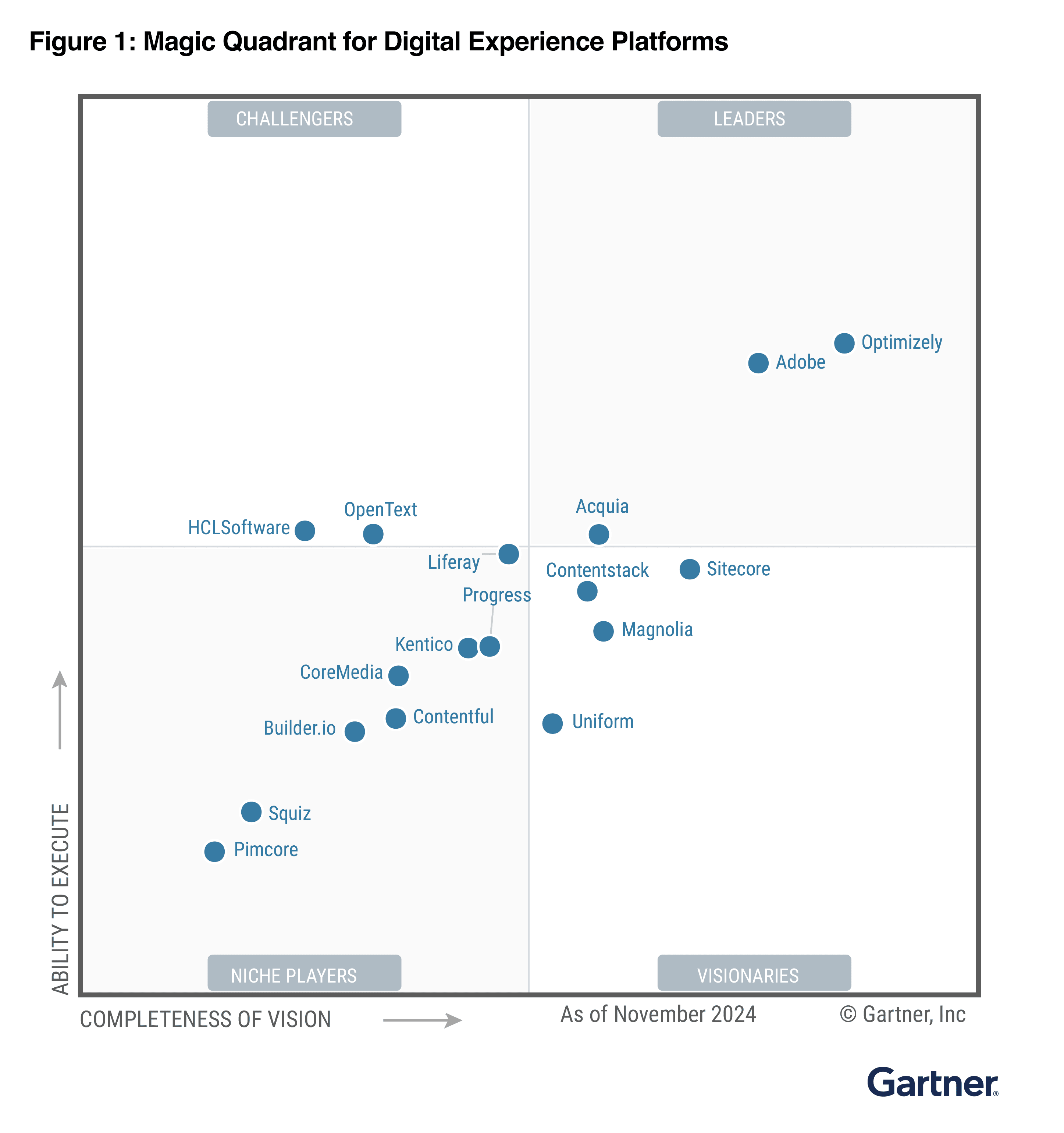
Uniform Recognized as a Visionary in 2025 Gartner® Magic Quadrant™ for Digital Experience Platforms
Learn More