



.svg)

.jpg)











Uniform blog/No excuses for unintegrated systems in 2026
No excuses for unintegrated systems in 2026
.png&w=256&q=75)
No excuses for unintegrated systems in 2026
TL;DR
Uniform's AI-powered composable platform eliminates the historic barriers to digital integration: slow migrations, dependency on developers for optimization, and fragmented system architectures. By enabling instant activation of AI, quick migrations, and intelligent experience optimization on existing infrastructure, Uniform proves there’s no excuse for disjointed digital systems in 2026. The key takeaway: modernization now takes weeks, not years, unlocking efficiency and growth for every organization.
Three barriers have historically justified fragmented digital architectures: AI capabilities require modern infrastructure first, migration timelines run six to twelve months, and experience optimization depends on developer availability. Uniform's AI-powered composable platform removes all three. The path forward is not a single decision but a sequence: activate immediately on existing infrastructure, migrate when the business case demands it, then hand optimization to an AI that runs continuously within brand-safe guardrails.
Do AI capabilities require a full migration first?
They do not. Teams can add a single script tag to any existing website and gain immediate access to personalization, A/B testing, and content editing through the Uniform Visual Workspace. No platform replacement. No architectural overhaul.
Less than 15% of enterprise websites run on modern front-end and composable architectures. EditMySite operates as a progressive enhancement layer running on top of an existing site without modifying the underlying codebase. Organizations on legacy CMS platforms, proprietary frameworks, or architectures whose original vendors no longer exist, gain AI capabilities on the timeline of a deployment, not a transformation program.
EditMySite is not a permanent solution for sites that require a modern foundation for performance, scalability, or governance. It is the activation layer, a catalyst for organizations to start running optimization immediately, while the case for full migration is being built or funded.
Why do migrations take so long?
Migration projects historically consume six to twelve months of planning, specialist labor, and frozen campaign capacity. Furthermore, only 48% of digital initiatives meet or exceed their business outcome targets, according to Gartner's 2025 CIO and Technology Executive Survey. This makes postponement easy to justify.
Uniform Siphon changes the denominator.
Siphon crawls live websites and reconstructs front-end architectures on modern frameworks without requiring source code access. Where EditMySite helps teams start the process by actively making changes to the current website, Siphon closes the gap. Organizations that activate on existing infrastructure with EditMySite and then migrate with Siphon compress what was once a multi-year sequence into weeks.
Why does experience optimization usually depend on a developer queue?
Most architectures require developer intervention for decisions that marketing teams can make independently. Every personalization configuration, A/B test, and experience variant becomes a ticket, a sprint, and a review cycle.
MuleSoft's 2026 Connectivity Benchmark Report found that 82% of IT leaders cite integration as one of the biggest challenges when deploying AI, with organizations averaging 957 applications and only 27% of them connected. The Uniform Visual Workspace connects to those existing systems through 70+ pre-built integrations without migrating or centralizing the underlying data, making content from any CMS, DAM, CDP, or commerce platform accessible for orchestration without a prior API project.
Scout, Uniform's agentic AI, handles the optimization layer autonomously. Scout generates SEO fixes, builds localized content variants, configures audience-based personalization from live analytics data, and creates A/B test variants, then executes changes within configurable role-based workflows where legal, brand, and editorial teams retain approval authority at each stage. As AI removes coordination overhead, humans retain control over what reaches production.
The development queue disappears not because marketers do more, but because AI does the work that slows them down.
What does fragmentation cost in 2026?
The case for staying on fragmented systems rested on one calculation: modernization risk exceeded the cost of standing still. That calculation has inverted.
TELUS realized $1.1M in ROI with a 60-times improvement in developer efficiency, reducing new experience delivery from weeks to hours. Leister Group successfully migrated to a composable, Uniform-led technology stack, halving annual platform costs while delivering faster development, greater marketer autonomy, and a cleaner architecture for future upgrades.
These outcomes are not available to companies waiting for migration conditions that may never align.
In 2026, the tools exist to activate AI capabilities on existing infrastructure now, migrate legacy systems in weeks, and replace developer bottlenecks with autonomous AI optimization, forever. The sequence is clear. The timeline is weeks, not years.
Schedule time with our experts to discover what Uniform’s AI-powered composable DXP can do for your business.
FAQ
EditMySite activates AI capabilities on any existing site immediately, no migration required. Siphon handles full front-end reconstruction when performance or governance demand a modern foundation. Most organizations run them in sequence. Because EditMySite stores personalization and A/B configurations within the Uniform project rather than the legacy codebase, that work carries into the migrated environment.
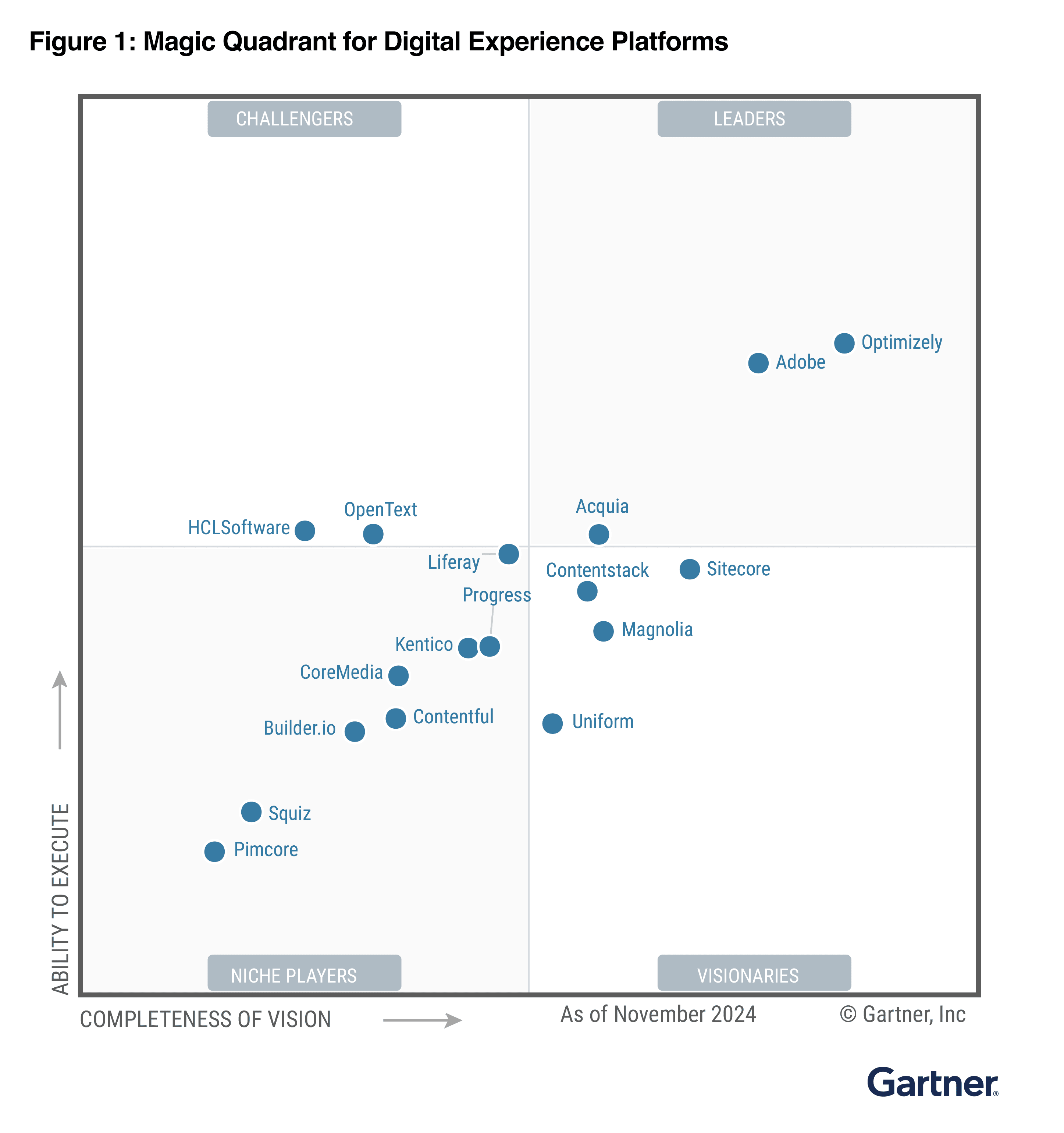
Uniform Recognized as a Visionary in 2025 Gartner® Magic Quadrant™ for Digital Experience Platforms
Learn More