






.svg)

.jpg)














Uniform blog/What makes a content platform agentic
What makes a content platform agentic
.png&w=256&q=75)
What makes a content platform agentic
TL;DR
What makes a content platform agentic, and why does the label "agentic" alone no longer help buyers evaluate vendors? Marketing teams need AI that reduces dependence on engineering across the existing stack, not features that are trapped in a single tool or require replatforming. The key takeaway: an agentic platform should work across systems, apply governance by default, and prove its value in real production use.
Twelve months ago, a vendor coined the term “agentic CMS”. Every major content platform now wears the label like a badge, and nearly all of them ship a connector to the Model Context Protocol, the open standard that lets AI assistants take action inside software.
When a claim becomes universal, it stops helping buyers choose.
The marketing leader evaluating these platforms still faces the problem the category was supposed to solve: campaigns wait on engineering, every content change routes through a development queue, and the distance between what marketing needs this week and what the stack can deliver keeps widening. The agentic label does nothing to close this distance. The architecture underneath it decides everything.
The badge has lost its meaning
A native protocol connector used to signal ambition; now it signals membership. Every platform across the category ships one or is building one, so the presence of agents no longer separates the field. Analysts have started to say the same thing in their own register.
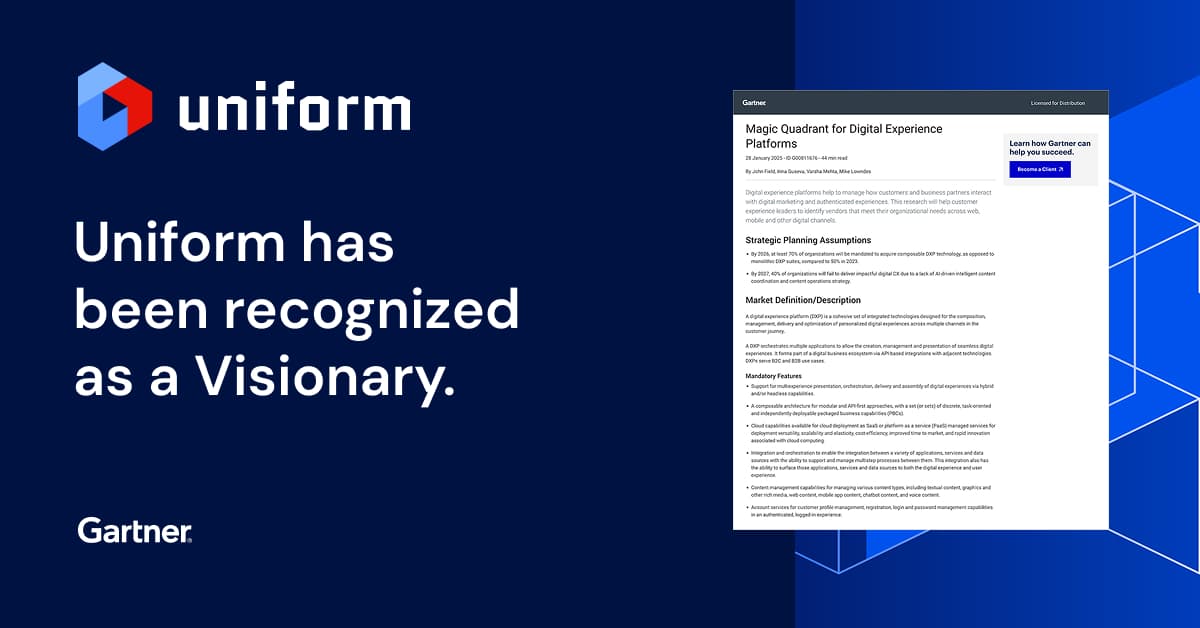
Gartner's 2026 Innovation Insight on agentic content management places the category in its emerging-technology tier and names three capabilities that define it:
- automation
- decisioning
- orchestration
The trade press is blunter about the noise. The Associated Press observed that what counts as agentic depends largely on who is selling it. A category this crowded rewards the platform that can state precisely what the word buys, while everyone else repeats it.
Three questions separate an agentic platform from an AI feature with good marketing:
- where the agents are allowed to work
- who stays in control
- whether the behavior is proven or promised
1. Agentic describes where the work happens
A platform earns the term when its agents read, write, and act across the tools an organization already runs, not only inside the platform that hosts them.
The distinction matters because most content work naturally crosses systems. A single campaign page pulls product data from a commerce engine, assets from a digital asset manager, and audience rules from a customer data platform. An agent confined to one system drafts copy and rearranges components, then stalls the moment the task crosses a boundary.
Reach is the first line of the test. Uniform's approach shows what cross-stack reach produces in practice. Its agent, Scout, connects to any tool that exposes a protocol server, from a commerce platform to a project tracker, and works across them inside one conversation, so a marketer assembles and updates a campaign without filing a separate request for each connected system.
An agent that operates across the stack removes coordination between marketing and engineering. An agent trapped in a single tool relocates that coordination and calls it progress.
2. Governance became the baseline
The second line of the test used to be the entire debate. Early skepticism about autonomous agents centered on control: what stops an agent from publishing something wrong, or acting on permissions it was never meant to hold?
The category answered fast. Permissions, audit trails, and human approval now appear on nearly every platform, which moves governance from a differentiator to a requirement. The question worth asking has shifted from whether a platform has approval controls to whether those controls run by default.
Uniform's agent queues its edits for review by default, presenting field-level changes for a person to approve before anything reaches a live page, with autonomous execution offered as a deliberate opt-in.
3. The proof is production
The third line is the hardest for some vendors to produce. Adoption of agentic AI runs nearly universal in intent and rare in execution. Forrester found that roughly three-quarters of enterprise leaders report adopting agentic AI, while only a small minority run it in meaningful production beyond scripted chatbots.
The space between those two numbers is where most agentic claims live. A platform selling a roadmap describes what its agents will do. A platform with production usage describes what they already do, at what volume, with what rate of error. A marketing leader can close the gap with one request: “Show the agent working on live content, on a real site, during our call.” Demonstrated behavior settles what a feature list cannot.
The test, and the rebuild it exposes
Three lines separate an agentic platform from an AI feature with a marketing budget: agents that span the stack, governance that runs by default, and behavior proven in production rather than promised on a slide.
The same lens exposes a condition buried in many agentic pitches. When agents operate only within one platform, adopting them means moving the surrounding stack onto that platform, which is a full replatforming under a friendlier name.
The market has already turned against this trade. The 2025 MarTech Replacement Survey recorded the lowest replacement rates in its history, and the replacement rate for the content platform itself fell from 15.7% to 10.5% in a single year. Marketing leaders are keeping the systems they have and orchestrating around them.
A good agent that respects this decision, working across the existing stack under human control, removing the friction between marketing and engineering instead of billing a migration to put it back.
Want to see how Uniform answers these questions? Schedule a quick chat now and you can see it for yourself.
FAQs
No. A true agentic platform lets its agents work across the systems you already run, rather than confining them to a single tool. If a platform's agents only operate within its own walls, adopting it would require a full replatforming—something most marketing leaders are actively avoiding.
.jpg&w=3840&q=75)
Gartner® Reports
Innovation Insight: Agentic CMS