



01 // The shift

Speed to market in 2026: the pipeline collapsed

Updated August 202612 min read

In shortPrompt to production

In 2026, teams no longer move through a sequential pipeline of design, then code, then content, then go live. Digital experiences start from a prompt: AI agents produce the design, code, and content in parallel as reviewable output, humans approve what ships, and the launch that took a quarter now takes hours. The steps did not disappear. The waiting between them did.

That claim needs defending, because every vendor now promises speed. This guide explains what changed in the mechanics of getting an experience live, why the old pipeline was slow in ways that better tools never fixed, and how to evaluate whether a platform actually compresses time to market or just demos well.

It draws on Uniform's work on what it calls the cold start problem and on the current generation of its agent, Scout, whose operating model shapes the second half of this guide.

Read: solving the cold start problemRead: Scout just got its biggest upgrade yet
02 // Old way

The old pipeline: a relay race where the baton does the waiting

For twenty years, launching a digital experience meant four phases in sequence. Brief written, then design produced, then handed to development, then components built, then the CMS configured, then content authored into it, then QA, then launch. Each phase was staffed by a different team with its own queue.

The work was days. The calendar was queues.

Design, then code, then content, then go live

  1. Waits on the brief

    01

    Design

    Concepts, comps, sign-off

  2. Waits on design sign-off

    02

    Code

    Components, templates, integration

  3. Waits on the CMS being ready

    03

    Content

    Authoring, translation, QA

  4. Waits on everyone

    04

    Go live

    Release checks, launch

Here is the uncomfortable arithmetic every delivery leader knows: the work in each phase was days; the elapsed time was weeks. The difference was queues. Design waited on the brief. Code waited on design sign-off. Content waited for the CMS to be ready. Go-live waited on everyone.

Add the platform itself: traditional DXP implementations routinely took six months or more before the first page could even enter this pipeline, which is why so much AI investment went into optimizing the hundredth page while the real bottleneck stayed exactly where it always had: launching the first one.

The result was a fixed cost of trying. When an idea costs a quarter to test, organizations test few ideas, and speed to market becomes a portfolio problem, not just a delivery problem.

03 // What changed

What changed: the prompt became the starting point

Three shifts landed together, and their combination is what collapsed the pipeline.

Design, code, and content stopped being phases and became outputs.

  1. Agents that execute end to end

    Modern agents do not suggest a headline for a human to place. Given an outcome, such as launching the spring campaign page in three markets, they produce the composition, the content, the translations, the accessibility pass, and the personalization wiring as one body of reviewable work. Execution replaced assistance.

    What is an agentic DXP?
  2. Codegen that produces production systems, not prototypes

    Prompt-to-UI tools proved that anyone can conjure a page in an afternoon; the gap was that the prototype couldn't enter the production stack without a rebuild. That chasm is closing: prompt-driven code generation now produces managed components and compositions that teams can operate afterward, which is the difference between a demo and a launch.

  3. Structured platforms agents can act on

    None of this works over page blobs. Typed content, componentized presentation, and protocol access through MCP are what let agents produce work that slots into a governed system instead of a pile of HTML. Speed to market in 2026 is downstream of the AI-readiness work.

    How to make content AI-ready

The relay

Brief, design, code, content, QA, live

Six sequential handoffs. Calendar time was spent in the gaps between them, not on the work itself.

The loop

  1. 01

    Prompt

    An outcome described in plain language

  2. 02

    Review

    Humans approve what ships

  3. 03

    Live

    The experience is in production

  4. 04

    Optimize

    Signals feed the next prompt

Four stages that repeat. Design, code, and content are produced in parallel inside the first one and reviewed in the second.

They are produced in parallel by agents and reviewed by the humans who used to produce them sequentially. The pipeline became a loop: prompt, review, live, optimize.

04 // Entry points

Start from anywhere: four entry points to production

The old pipeline had one door: the brief. The new model has an entry point for wherever your project actually is today. On Uniform, the four look like this.

One door became four. Start from wherever you actually are.

  1. 01

    Start from a prompt

    Preview

    Uniform Code, in Preview, generates production code from a prompt: components, compositions, and structure are built as managed entities from the start, so what you generate is what your team operates. This is vibecoding with a production destination.

  2. 02

    Start from a prototype

    Teams already prototype in tools like Lovable and v0. Through Uniform's MCP server, a coding agent can turn that prototype, or an existing React component, into managed Uniform components and compositions, so the afternoon prototype becomes the v1 your whole team can work on rather than a throwaway.

  3. 03

    Start from an existing site

    With EditMySite, an existing page becomes optimizable by URL: personalization and experimentation apply on top of what is already live, with no migration and no rebuild. Speed to market sometimes means not moving at all.

  4. 04

    Start from a legacy platform

    When migration is the right call, Siphon automates the lift: content moves and the front end is reconstructed with AI on a modern stack, compressing what has historically been one of the most expensive projects in enterprise IT.

05 // Operate

Launch fast, then stay fast: operating at prompt speed

Fast launches are worthless if week two returns to ticket queues. The skeptic's objection to everything above is maintenance, and it is the right objection. The answer is that the same agent that launched the experience operates it. Scout, Uniform's agent, runs the post-launch loop, and its current generation is built for exactly the concerns that make enterprises hesitate.

Read: Scout just got its biggest upgrade yet

A fast launch is table stakes. Staying fast is the differentiator.

Skills

Speed without brand drift

Skills encode how your team works: voice, design system rules, audit criteria, compliance checks. Scout produces your content and your compositions, not generic output, because the standards are taught once and applied everywhere.

  • Your voice and design system applied to every output
  • Standards are taught once, not re-explained request by request

Scale

The hundredth change as fast as the first

Vector search finds anything in plain language, and bulk operations apply a described change across every matching entry: refresh outdated references, fill missing metadata, retag a content library against a new personalization taxonomy.

  • One described change applies across every matching entry
  • Scale stops costing calendar time

Governance

Autonomy you dial, not toggle

Every operation runs in autonomous mode, where changes are drafted directly and reviewed before publishing, or in review mode, where Scout proposes and humans select and approve. Routine metadata runs in autonomous mode; brand-critical pages get review.

  • Routine work runs autonomous, brand-critical pages get review
  • Governance is in the loop, not bolted on after

This is the full shape of the 2026 model: Uniform Code (in Preview) and the entry points above get you to production; Scout keeps you at production speed afterward. Throughput stops depending on how many people are free, and the team's time concentrates on the decisions that matter.

06 // Worked example

What a day actually looks like

A concrete workflow, with the approval steps visible, because that is where the credibility lives.

One human decision, made once, at the moment it matters.

  1. 01

    Morning

    A marketer prompts for a campaign landing page: audience, offer, three markets. The agent reads the design system and brand skills, drafts the composition, content, and locale variants, and stages everything for review.

  2. 02

    Midday

    The team reviews the diff, adjusts the offer copy in one market, and approves. The page goes live. Nothing shipped without a human decision.

    Old calendar

    Content authored in week eight, then QA and launch in weeks nine and ten.

    Same decision, same day

    Reviewed, adjusted, approved, and live before the afternoon.

  3. 03

    Afternoon

    The marketer asks for a personalization strategy against existing audiences. The agent proposes signals and variants, the team approves the subset worth running, and experiments start collecting data.

The old calendar for the same outcome: brief in week one, design in weeks two and three, development in weeks four through seven, content in week eight, QA and launch in week nine or ten. The work was never ten weeks. The waiting was.

07 // Unchanged

What deliberately does not change

Speed earns trust only if the guardrails hold. Three things the prompt-to-production model keeps, on purpose.

Read: MCP for content management
  1. 01

    Humans approve what ships

    People request outcomes, agents execute them, and people approve them. The decision points move to where judgment matters; they do not disappear.

  2. 02

    Brand and compliance are enforced, not hoped for

    Encoded standards apply to every output uniformly, which in practice makes agent-produced work more consistent than the old pipeline's handoffs, where standards lived in individual heads.

  3. 03

    The audit trail is complete

    Every agent action is attributable, logged, and reversible. Moving fast and knowing exactly what happened are the same feature.

08 // Measure

Measuring speed to market: two numbers that matter

Speed claims are only as good as the measurements behind them. Two numbers tell you whether a platform compresses time to market or only demos well.

Two numbers: time to first live, cycle time per change.

  1. 01

    Time to first live experience

    From decision to a production experience users can touch. The 2026 benchmark for a campaign-scale experience on an agentic platform is hours to days; a quarter means the pipeline, or the platform under it, is the constraint.

  2. 02

    Cycle time per change

    From request to approved and live for a routine change. This is the number that reveals whether launch speed survives contact with operations; bulk operations and dialed autonomy are what keep it flat as volume grows.

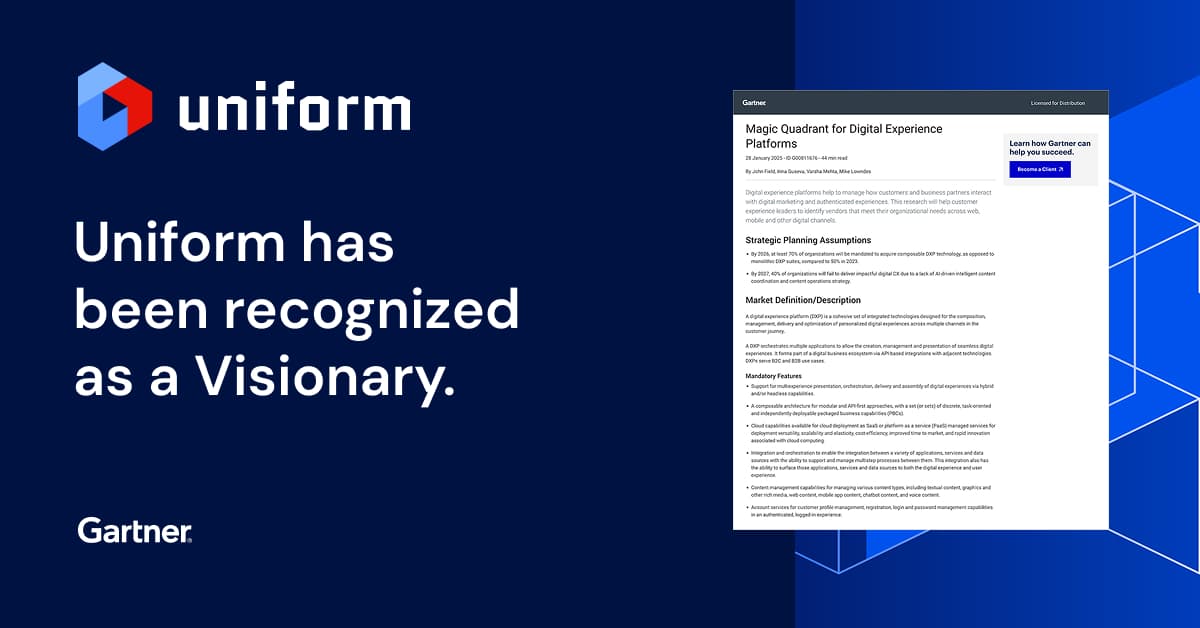
Watch both together. Entry points compress the first number; agent operations compress the second. A platform that only improves one has solved half the problem, and Gartner's guidance on agentic adoption points in the same direction: prove value on controlled, low-risk workflows with continuous measurement of completion rates and intervention frequency, then expand (Gartner®, Innovation Insight: Agentic CMS, Irina Guseva, Mike Lowndes, 12 May 2026).

Gartner research

The research behind the shift

Gartner® Innovation Insight on agentic CMS covers how agentic capabilities change content operations and what to measure while adopting them. Complimentary report access, courtesy of Uniform.

Gartner, Innovation Insight: Agentic CMS, Irina Guseva, Mike Lowndes, 12 May 2026.

09 // FAQ

Frequently asked questions

Short answers to the questions teams ask when they are deciding how fast they can actually move.

Digital experiences now start from a prompt rather than a sequential pipeline: AI agents on platforms such as Uniform produce design, code, and content in parallel as reviewable work, humans approve what ships, and launches that consumed a quarter of handoffs and queues are complete in hours or days.

No. The steps still happen; they become parallel outputs an agent produces for human review, rather than sequential phases with queues between them. Designers, developers, and content teams shift from producing every artifact to setting standards, reviewing work, and deciding what ships.

The gap between prototype tools like Lovable or v0 and production is managed through structure. Uniform's MCP server lets a coding agent convert prototypes and existing components into managed components and compositions, and Uniform Code (in Preview) generates production structure directly from a prompt, so the prototype becomes an operable v1.

A campaign-scale experience can go from prompt to approved and live within a day on Uniform, because the agent drafts composition, content, translations, and personalization in parallel, and humans review once. Larger builds and migrations take longer, but weeks rather than the six-month implementations traditional DXPs required.

Not when standards and approval are built into the agent loop: encoded skills enforce voice, design system, and compliance on every output, consequential actions route through human review, and every agent action is logged and reversible. In practice, this is more consistent than sequential handoffs between teams.

Track two numbers: time to first live experience (decision to production) and cycle time per routine change (request to approved and live). Improve the first with better entry points to production and the second with agent operations such as bulk changes; a healthy 2026 baseline is hours to days for both.

10 // Next

The web has two audiences. Build for both.

Prompt to production, then production speed afterward. Point an agent at your standards, your design system, and your content, and see what a day of work looks like.

Uniform Code is in Preview