





01 // The fit

SAP Commerce Cloud + Uniform: keep the engine, transform the experience

Updated August 202612 min read

DefinitionSAP Commerce Cloud experience layer

SAP Commerce Cloud runs the commerce: catalog, pricing, entitlements, cart, checkout, and order orchestration. Uniform is the experience layer on top: it composes SAP Commerce data with content, customer data, and personalization into fast, adaptive experiences that marketers operate visually and AI agents operate at scale, without replacing SAP Commerce Cloud or duplicating what it does.

Your SAP Commerce Cloud implementation carries years of encoded commercial logic: contract pricing, entitled catalogs, B2B units, promotions, order processes. Rebuilding that anywhere else is a multi-year project nobody wants to price, which is why rip-and-replace pitches stall in procurement.

Uniform starts from the opposite premise: the engine stays. What changes is everything a customer sees and touches around it: the storefront, the campaigns, the personalization, the portal, and the answers AI agents give when they shop on a buyer's behalf. That surrounding layer is where the untapped revenue in an SAP investment lives, and it is the layer Uniform provides.

TL;DR // 30 seconds

SAP Commerce Cloud keeps the commerce running. Uniform adds the experience layer on top. What that buys you: personalization across the whole funnel instead of a banner, campaigns launched by marketers in days instead of developer-quarters, and Scout operating experience quality across your entire catalog. Nothing is replaced, adoption is incremental, and the first composed experience on live SAP data ships in days.

03 // Why now

Why SAP customers are deciding this now

Three clocks are running at once.

Three deadlines, one decision: frontend, expectations, and agents are cheapest solved together.

Clock 01 // Frontend

The Accelerator clock

SAP's Commerce Accelerator storefronts are reaching end-of-life [verify date and scope against current SAP documentation before publishing], which turns the frontend question from a someday project into a dated decision. Every SAP Commerce customer is choosing what comes next: SAP Composable Storefront, a custom frontend, or an experience platform above the frontend.

Clock 02 // Expectations

The expectations clock

B2B buyers compare your storefront to the best experience they used yesterday, not to your nearest competitor. Static, developer-gated experiences on top of excellent commerce engines are the norm this audience is leaving behind.

Clock 03 // Agents

The agent clock

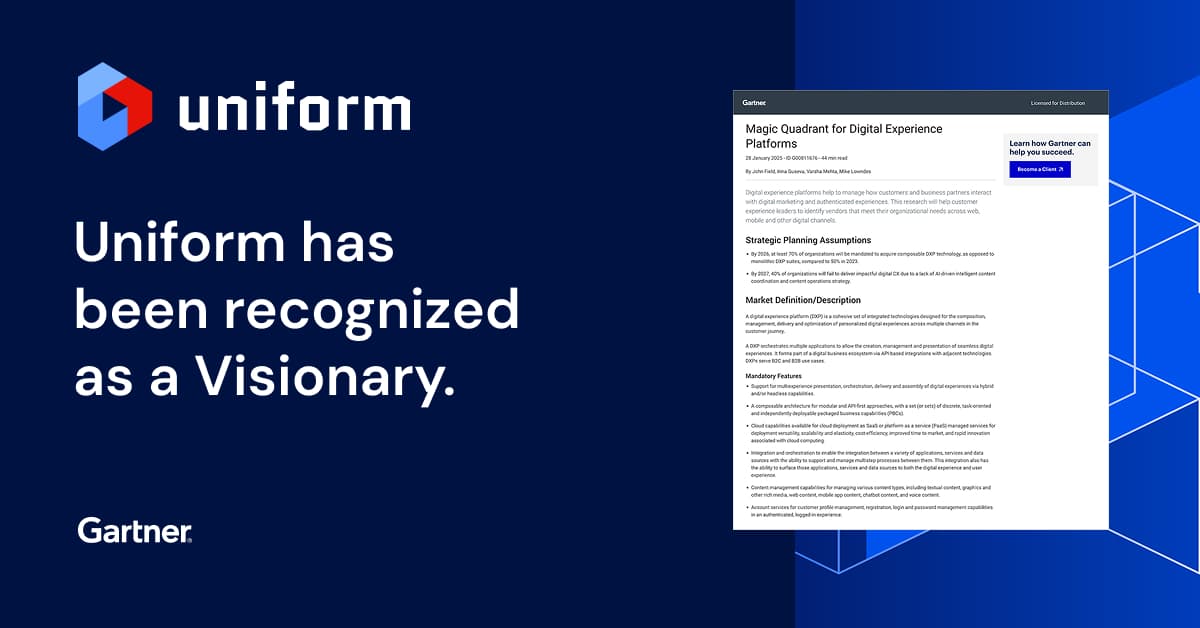
Commerce is acquiring a second audience: answer engines and buying agents that discover, compare, and increasingly transact on behalf of customers. By 2028, 80% of customer interactions will shift from web, search, social, mobile applications, and other traditional digital CX channels to agentic AI interfaces. (Gartner®, Innovation Insight: Agentic CMS, Irina Guseva, Mike Lowndes, 12 May 2026).

Get the Gartner® report

The Accelerator decision is the moment to solve all three, because the frontend choice and the experience-layer choice are cheaper made together than sequentially.

04 // Boundaries

Clean boundaries: what each system is best at

The pairing works because each system keeps the job it does best, and the architecture enforces the boundary rather than leaving it to project-team goodwill. Two design principles keep that boundary honest, separating implementations that hold up under real buyer traffic from those that need a rescue project by the second quarter.

SAP stays the only source of commercial truth. Uniform is the only place experience is decided.

Experience layer

Uniform

CompositionContentPersonalizationExperimentation

References products by identifier

Resolves commerce per authenticated buyer

Commerce engine

SAP Commerce Cloud

CatalogPricing and contractsEntitlementsCart and checkout
The diagram shows two layers. Uniform sits above as the experience layer, holding composition, content, personalization, and experimentation. SAP Commerce Cloud sits below as the commerce engine, holding catalog, pricing and contracts, entitlements, and cart and checkout. Only two things cross the line between them: Uniform references SAP products by identifier on the way down, and SAP resolves commerce per authenticated buyer on the way up.
Division of responsibility between SAP Commerce Cloud as the commerce engine and Uniform as the experience layer.
SAP Commerce Cloud ownsUniform owns
Product catalog and SKUsExperience composition and layout
Pricing, contract pricing, promotionsContent: campaigns, editorial, education, brand
Entitlements and catalog visibilityPersonalization and experimentation
Cart, checkout, tax, order orchestrationOrchestration of content, data, and commerce sources
Customer and B2B unit records (with SAP S/4HANA)Visual authoring, workflows, and agent operations
The transactionThe experience around the transaction

Commercial values never live in the experience layer.

Experiences reference SAP products by identifier; they never store prices, stock, or entitlements. Anything commercial is resolved by SAP at request time, per authenticated buyer, so there is never a second copy of commercial truth for the two systems to fight over.

The experience layer composes; SAP decides.

Merchandisers choose which products appear, how they are filtered, sorted, and combined with content. What each signed-in buyer actually sees (their price, their availability, their entitled subset) is SAP's answer, applied at render. One authored experience, resolved correctly for every account.

05 // B2B reality

What B2B commerce demands from the experience layer

B2B breaks naive experience layers in the same four places every time. Design for them from day one:

If it has not been previewed as a real account, it has not been tested.

Authored once

One campaign experience

Layout, content, and product rules, with products referenced by identifier.

Resolved by SAP

National account

Catalog
Full entitled range
Price
Contract tier A
Promotion
Volume rebate

Regional distributor

Catalog
Entitled subset
Price
Contract tier B
Promotion
None active

Illustrative values

The diagram shows one authored campaign experience on the left, holding layout, content, and product rules with products referenced by identifier. SAP resolves it into two different renderings on the right. A national account sees the full entitled range at contract tier A with a volume rebate; a regional distributor sees an entitled subset at contract tier B with no active promotion. The values are illustrative.
  1. 01

    Every account renders its own version

    One authored campaign experience produces a different outcome for every authenticated buyer: entitlement trims the product set, contract terms rewrite the prices, and a SKU that headlines the campaign for one account may not exist in another account's catalog at all. Plan authoring and QA should focus on account-level outcomes rather than a single canonical page.

  2. 02

    Preview as your buyers, not as the public

    Anonymous preview shows a storefront that none of your contracted buyers will ever see. Uniform's preview renders the experience for selected accounts, so a merchandiser can verify the actual outcome for a key account before publishing: their entitled products, prices, and promotions.

  3. 03

    Two cache policies, enforced by design

    Composition and content are safe to cache long at the edge. Entitled prices and availability are not safe to share beyond the buyer they belong to. Uniform's delivery keeps those two policies separate by design, so performance never risks showing one account's negotiated terms to another.

  4. 04

    Catalog drift is an operations problem, so give it an operator

    SAP catalogs evolve on their own release cadence: products retire, categories reorganize, identifiers change. Continuous reconciliation between live experiences and the current catalog is part of operating the layer, and it is exactly the kind of always-on task Scout runs, so nobody learns about a broken campaign from a customer email.

06 // Beyond CMS

Why an experience layer, not just a CMS in front

Putting a headless CMS in front of SAP Commerce Cloud is a well-known pattern, and it genuinely improves the content half of the problem. It also stops at the content half. The team still hand-assembles everything else: personalization runs in another tool, experimentation in another, customer data arrives through custom code, and every additional source (DAM, search, recommendations, a second CMS from an acquisition) adds another point-to-point integration for developers to own. Uniform is an orchestration layer rather than another silo in front of the engine:

A CMS in front of SAP upgrades the content. An experience layer upgrades the revenue.

  1. 01

    One composition across every source

    A single experience combines SAP products and pricing, CMS content (Uniform's own best-in-class headless CMS, or the CMS you run, or both), customer data from any CDP including SAP Emarsys, assets, search, and proprietary APIs. Marketers compose it visually; developers define the components and guardrails once.

  2. 02

    Personalization and experimentation are native, with one decision-maker per slot

    Signals from customer data and live behavior drive edge-side, flicker-free personalization across the whole experience, not just a banner, and A/B testing is built in rather than bolted on. This is where the conversion case is made or lost: relevance applied across products, promotions, content, and navigation lifts conversion events at every funnel step, and native experimentation finds winning variants faster and compounds. Because composition happens in one layer, you avoid the classic failure of two systems fighting over the same slot: SAP remains the sole authority on pricing and eligibility, and Uniform is the sole authority on experience.

  3. 03

    The portal is an experience too

    The same composition and personalization apply behind login: My Account, support content, education, and promotions adapt per customer, turning an SAP-powered portal from an account interface into a sales and engagement channel with revenue attached: reorders, cross-sell, and renewals happen where the customer already is. For strategic accounts, it goes fully one-to-one: a salesperson can ask Scout to create a personal message with the latest enterprise catalog for a specific customer, and it is waiting in their portal on their next visit.

  4. 04

    No rip-and-replace, in any direction

    Keep SAP Commerce Cloud. Keep your existing CMS if you have one; Uniform orchestrates it. Adopt the layer incrementally: one campaign, one section, one market, at your pace.

None of this asks SAP Commerce Cloud to change. The engine keeps its job, and the experience around it stops being a collection of point-to-point integrations that only developers can safely touch.

07 // Agentic

The agentic difference: operating commerce experiences at SKU scale

An experience-layer decision made in 2026 has to answer a question that one made in 2023 did not. Large SAP implementations run thousands to hundreds of thousands of SKUs, and the experience work around them (enrichment, metadata, variants, optimization) has always scaled with headcount. On Uniform it scales with compute instead of headcount:

Your catalog size stops being the ceiling on your experience quality.

  1. 01

    Dynamic experience templates across the catalog

    Define the product-page experience once (SAP data, marketing content, FAQs, related products, recommendations, SEO and GEO/AEO content) and let it resolve dynamically against the SAP catalog, with per-product overrides where needed. Thousands of rich pages from one model.

  2. 02

    Scout executes the operations

    Bulk-enrich product pages, generate missing metadata, audit and fix content against brand and accessibility standards, roll out a personalization taxonomy across the library, and optimize continuously for the answer engines and shopping agents that now mediate B2B discovery. Teams request outcomes; Scout executes in autonomous or review mode; humans approve what ships.

  3. 03

    Natural language is an operating interface

    A merchandiser can ask for four drones between $5,000 and $10,000, sorted by price in descending order, and Scout translates that intent into the right query against SAP Commerce Cloud and configures the component. Visual editing, configuration, and language are one workflow, governed by the same permissions as everything else.

  4. 04

    Work starts where your team already is

    Through MCP, Scout and Uniform can be driven from collaboration tools and agent platforms your team already uses, so a salesperson or service agent can trigger an experience change without opening either Uniform or SAP.

    Read the MCP guide
  5. 05

    Your commerce becomes legible to buying agents

    The same structured, semantic delivery that serves human buyers makes products and content addressable by the AI agents shopping on their behalf: the dual-audience requirement, applied to commerce.

    Read the AI-ready guide
08 // Adoption

The adoption path: additive, incremental, reversible

Four moves, in the order most SAP customers make them. None requires a migration to start, and none locks you into the next one.

Every step is useful on its own, and every step leaves SAP exactly where it is.

  1. 1Start with one experience
  2. 2Modernize the storefront at your own pace
  3. 3Extend to the portal and personalization
  4. 4Turn on the agentic operations

SAP Commerce Cloud unchanged throughout

The stepper shows the four adoption steps in order, left to right: start with one experience, modernize the storefront at your own pace, extend to the portal and personalization, then turn on the agentic operations. A constant rail underneath marks SAP Commerce Cloud as unchanged at every step.
  1. 01

    Start with one experience

    A campaign page or landing experience composed on live SAP data, shipped in days. This is also the controlled proof of concept that agentic adoption guidance recommends: low-risk scope, measurable results.

  2. 02

    Modernize the storefront at your own pace

    Uniform works with SAP Composable Storefront or a custom frontend (for example, Next.js) with edge delivery; the frontend choice stays yours and can evolve independently of SAP Commerce Cloud.

  3. 03

    Extend to the portal and personalization

    Bring authenticated experiences and customer-data-driven personalization once the composition pattern is proven.

  4. 04

    Turn on the agentic operations

    Templates across the catalog, Scout-run enrichment and optimization, GEO/AEO for agent-mediated discovery.

At every step, SAP Commerce Cloud remains the system of record it already is. Nothing is migrated to get started, and nothing is locked in as you scale.

09 // FAQ

Frequently asked questions

Answer-first responses to what SAP Commerce Cloud teams ask before committing to an experience layer.

No. SAP Commerce Cloud remains the commerce engine and system of record for products, pricing, entitlements, cart, checkout, and orders. Uniform is the experience layer on top: it composes SAP Commerce data with content, customer data, and personalization into experiences, and never duplicates or overrides SAP's commercial logic.

No. Uniform includes a best-in-class headless CMS and also orchestrates the CMS you already run, so existing content systems keep working while Uniform composes their content together with SAP Commerce data into one experience. Migration is optional and can happen gradually or not at all.

Uniform references SAP products by identifier and never stores prices, stock, or entitlements; commercial data resolves from SAP Commerce Cloud at request time per authenticated buyer. Experiences stay fast through edge delivery of content and composition, while entitled pricing is fetched live and never shared across buyers.

A CMS in front of SAP improves content authoring but leaves personalization, experimentation, customer data, and every additional source as separate integrations. Uniform is an orchestration layer: it composes all of those sources into one visually authored experience, with personalization and A/B testing native and agentic AI operating the whole.

Both. Uniform composes the experience and delivers it through modern frameworks such as Next.js or alongside SAP Composable Storefront, with edge delivery for performance. The frontend choice remains yours and can evolve independently, which matters as SAP Accelerator storefronts reach end-of-life. [Verify EOL reference before publishing.]

Two things. Inside the platform, Uniform's agent Scout executes experience work at catalog scale: bulk product-page enrichment, metadata, audits, personalization rollouts, and GEO/AEO optimization, with humans approving what ships. Outside it, Uniform's structured delivery makes products and content legible to the answer engines and buying agents that increasingly mediate B2B purchasing.

The first composed experience on live SAP data typically ships in days as a low-risk proof of concept, then adoption expands incrementally: storefront modernization, portal personalization, and agent-operated catalog experiences, each at your own pace, with SAP Commerce Cloud unchanged as the system of record throughout.

10 // Next

SAP runs the commerce. Uniform turns it into an experience.

The web has two audiences. Build for both.

Gartner®, Innovation Insight: Agentic CMS, Irina Guseva, Mike Lowndes, 12 May 2026.