







.svg)

.jpg)















Uniform blog/AI productivity without connected architecture produces unattributed waste
AI productivity without connected architecture produces unattributed waste
.png&w=256&q=75)
AI productivity without connected architecture produces unattributed waste
TL;DR
AI-driven marketing productivity often fails to translate into measurable revenue without a connected architecture. As marketing budgets plateau and AI adoption accelerates, many organizations generate more content without the personalization, experimentation, and attribution needed to link these gains to business outcomes. The key takeaway: only integrated digital experience platforms that unify AI, content management, and measurement workflows can transform AI-generated productivity into provable ROI.
Marketing budgets have flatlined at 7.7% of company revenue for two consecutive years. 59% of CMOs report an insufficient budget to execute their strategy. GenAI adoption surged 116% year-over-year within those same budget constraints, now deployed across 15.1% of marketing activities. The Gartner 2025 CMO Spend Survey captures a marketing function under permanent budget pressure, turning to AI as a force multiplier because headcount expansion and agency growth are no longer options.
The productivity gains are arriving. The revenue attribution is not.
What the budget constraint forces
Small businesses moved fastest. Over 90% now use at least one AI tool, up from 40% in early 2025. For organizations with limited staff and no agency relationships, AI replaces headcount that was never available in the first place. Content volume increases. The constraint remains the same: no budget for the personalization, testing, and optimization infrastructure that would connect volume to conversion.
Mid-market companies formalized the bet. RSM's 2025 survey found that 76% now maintain dedicated AI budgets, and 88% of those expect increases. The challenge: 92% of these same organizations encountered implementation barriers, including data quality, security, and skills gaps, that prevent AI from operating beyond content generation into the measurement workflows that prove ROI.
Enterprise marketing absorbed the sharpest version of the constraint. Gartner found that 39% of CMOs plan to reduce agency budgets, 39% seek labor reductions, and 22% report that generative AI has already reduced their reliance on external agencies. The agency budget a CMO cuts today becomes the CFO's "found money" tomorrow, unless the architecture exists to reallocate it into high-conversion experimentation. The question is whether the technology architecture converts that reallocation into provable revenue impact, or whether it produces more content that cannot be attributed to business outcomes.
Why productivity without attribution creates a new problem
The Wharton 2025 AI Adoption Report tracked enterprise adoption of generative AI over three years. Weekly usage climbed from 37% in 2023 to 82% in 2025. Spending increased 130% between 2023 and 2024 alone. The critical shift in the 2025 data: 72% of enterprise leaders now formally measure generative AI ROI, up from a period where most organizations tracked adoption metrics rather than business outcomes.
The accountability era arrived at the same time as the budget ceiling. CMOs who justified AI investments on productivity grounds now face a follow-up question from the CFO: What revenue did the productivity produce?
Gartner's own findings reveal the tension. GenAI investments deliver ROI through improved time efficiency (49%), cost efficiency (40%), and increased content capacity (27%). Those are input metrics. The 27% of CMOs who report no meaningful generative AI adoption and the 25% who see little benefit from cost reduction efforts suggest that a significant share of the market has not connected AI productivity to revenue outcomes.
The question budget-accountable leaders need to answer
AI adoption will continue accelerating under permanent budget constraints because there is no alternative path to increased capacity. The differentiating question is architectural: does the organization's martech stack connect AI-generated content to personalization, experimentation, and conversion measurement within a single integrated workflow?
For organizations where the answer is yes, every AI productivity gain compounds. Faster content feeds faster experiments, faster experiments produce faster optimization, and faster optimization produces measurable revenue attribution that justifies continued investment.
For organizations where the answer is no, AI produces more content that marketing cannot connect to outcomes, the CFO questions the investment, and the budget constraint becomes a budget dead end.
Your AI is generating content. Is it generating revenue? Schedule time now to learn how to connect your marketing tech stack to revenue attribution and transform AI productivity into measurable business outcomes.
FAQs
Composable orchestration unifies content creation, personalization, experimentation, and conversion measurement within a single workflow, compressing the cycle from content to revenue attribution from weeks to hours.
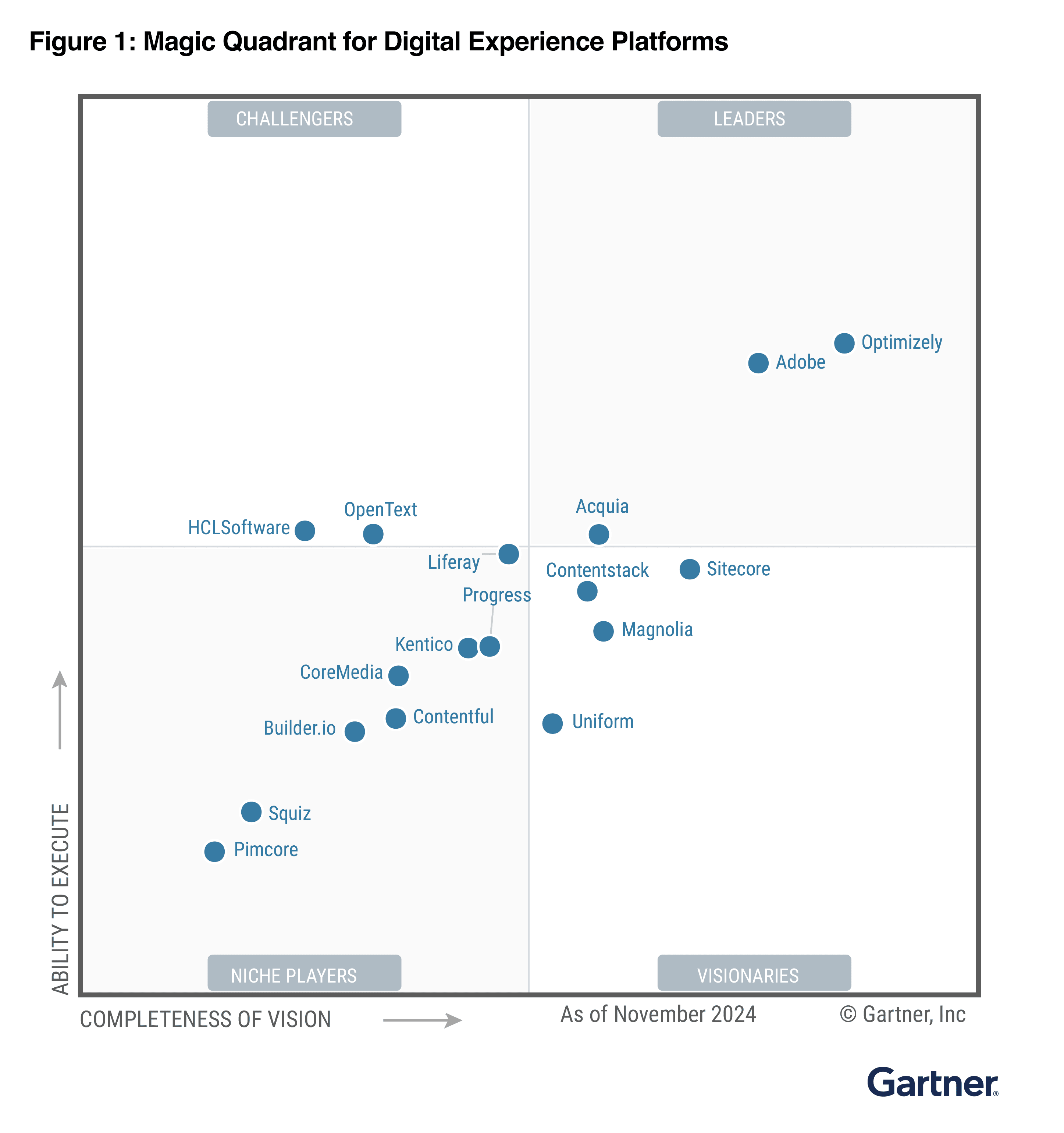
Uniform Recognized as a Visionary in 2025 Gartner® Magic Quadrant™ for Digital Experience Platforms
Learn More