





.svg)

.jpg)





.png&w=2048&q=75)







Uniform blog/Speed to experience is speed to revenue
Speed to experience is speed to revenue
.png&w=256&q=75)
Speed to experience is speed to revenue
TL;DR
Most organizations struggle to deliver real-time personalization, pinpointing architectural delays as the root cause—even when ambition and investment are high. Outdated, tightly coupled digital architectures create friction between insight and experience, slowing the impact on revenue. The takeaway: adopting a composable, edge-native architecture like Uniform enables speed-to-experience, empowering teams to rapidly deliver personalized digital experiences and accelerate business growth.
Adobe's 2026 AI and Digital Trends report finds 80% of organizations are pursuing real-time personalization as their primary CX ambition. Only 36% consider themselves ahead on digital CX maturity. The gap between those two numbers has an architectural explanation.
Why real-time personalization ambition outpaces delivery
Adobe's research frames the stakes precisely. Half of customers give promotional content two-to-five seconds to earn their attention before disengaging. Personalization, in this context, is the measurement of speed in which an organization responds to a customer signal, converts that signal into a relevant experience, and delivers it before the window closes.
Organizations that cannot compress this timeline do not fail because their marketing teams lack skill or ambition. They fail because their martech stack delays at every step. This data confirms the pattern: generative AI investment is widespread and personalization metrics are improving, yet many organizations still cannot describe themselves as ahead of the curve on digital CX maturity.
Investment and execution diverge when the architecture between them creates friction at every stage.
Why dominant platforms share the same structural constraint
Sitecore, Optimizely, and Adobe Experience Manager represent the established center of the enterprise DXP market. Organizations running these platforms have invested heavily in personalization roadmaps, and the platforms have invested heavily in personalization features.
The architectural model underlying all three platforms is the constraint.
Each was engineered in an era when the platform owned the experience end-to-end. Content lived inside the platform, presentation logic coupled tightly to the content, and personalization decisions processed server-side after the page request was already in motion. The model made sense when campaigns ran on weekly cycles and personalization meant showing a different banner to logged-in users.
In a real-time personalization environment, server-side coupled architecture creates a cascade of delays that compound into weeks.
- Personalization decisions made after the request introduce visible content flicker as the default experience renders before the personalized version loads.
- Flicker degrades conversion rates and creates SEO penalties that undermine organic traffic.
- Content changes for new audience segments require development cycles because presentation and content are not separated at the architecture level.
- Data from the CDP, CRM, and behavioral signals cannot feed personalization decisions in real time because each connection requires a custom integration project.
One Fortune 1000 insurance company that migrated off Sitecore summarized the operational reality directly: "We needed to switch from Sitecore, and it was clear that Uniform was the right solution."
The barrier to switching had been the migration timeline, not the strategic rationale. The strategic rationale was never in doubt.
What speed to experience requires architecturally
Three architectural conditions must be true for speed to experience to translate into speed to revenue.
- Personalization decisions must happen before the page renders. Edge-native personalization, delivered at the CDN level before the first byte reaches the browser, eliminates flicker and ensures search engines index the personalized experience rather than the default fallback.
- Content changes for new audience segments must not require a developer. When presentation components are separated from the content powering them, marketing teams can configure new personalized variations without filing a development request.
- Data from the CDP, CRM, and behavioral signals must connect to the experience layer through an orchestration architecture, not through custom integration work. A composable platform that connects via API (ideally through pre-built integrations) across CMSs, CDPs, DAMs, commerce, and other systems enables personalization decisions to draw from real-time behavioral signals, audience enrichments, and third-party data without a separate integration project for each connection.
What CMOs achieve when the architecture matches the ambition
VyStar Credit Union deployed edge personalization on Uniform's composable platform. Personalized sessions moved from 4% to 82% in two months. The conversion improvement followed directly from the increase in coverage: the architecture stopped manufacturing delays between insight and delivery, and the revenue impact followed.
TELUS, the Canadian telecommunications provider, restructured its digital experience operations on Uniform. The marketing team moved from developer-dependent workflows to autonomous campaign execution. The financial outcome: $1.1M in ROI captured in Year 1 from developer efficiency alone, before accounting for the revenue impact of faster campaign deployment.
The pattern across both organizations is the same. Removing the architectural delay between insight and personalized experience improves conversion rates on individual campaigns and reshapes the operating model for the marketing function entirely.
The diagnostic question worth asking before the next planning cycle
The gap between the 80% personalization ambition and actual delivery traces to architecture, not to technology adoption.
Organizations have the AI tools and most have the audience data. The bottleneck is clearly the architecture governing how long it takes to move from insight to live personalized experience.
The diagnostic question is concrete: how many calendar days does the current martech stack require to move a new audience segment from identification to a live personalized experience on the primary digital property?If the answer exceeds 48 hours, the architecture is not supporting the revenue ambition.
Coupled architecture produces that delay by design. Composable architecture removes it by design.
Schedule an architecture assessment with our experts and discover how edge-native personalization can compress your speed to experience from weeks to hours—and turn ambition into measurable revenue growth.
FAQs
Speed to experience measures the time between identifying a new audience segment or behavioral signal and delivering a relevant personalized experience to that audience on a live digital property. In coupled architecture environments, that timeline typically extends to weeks. In composable architecture environments with edge-native personalization, it compresses to hours.
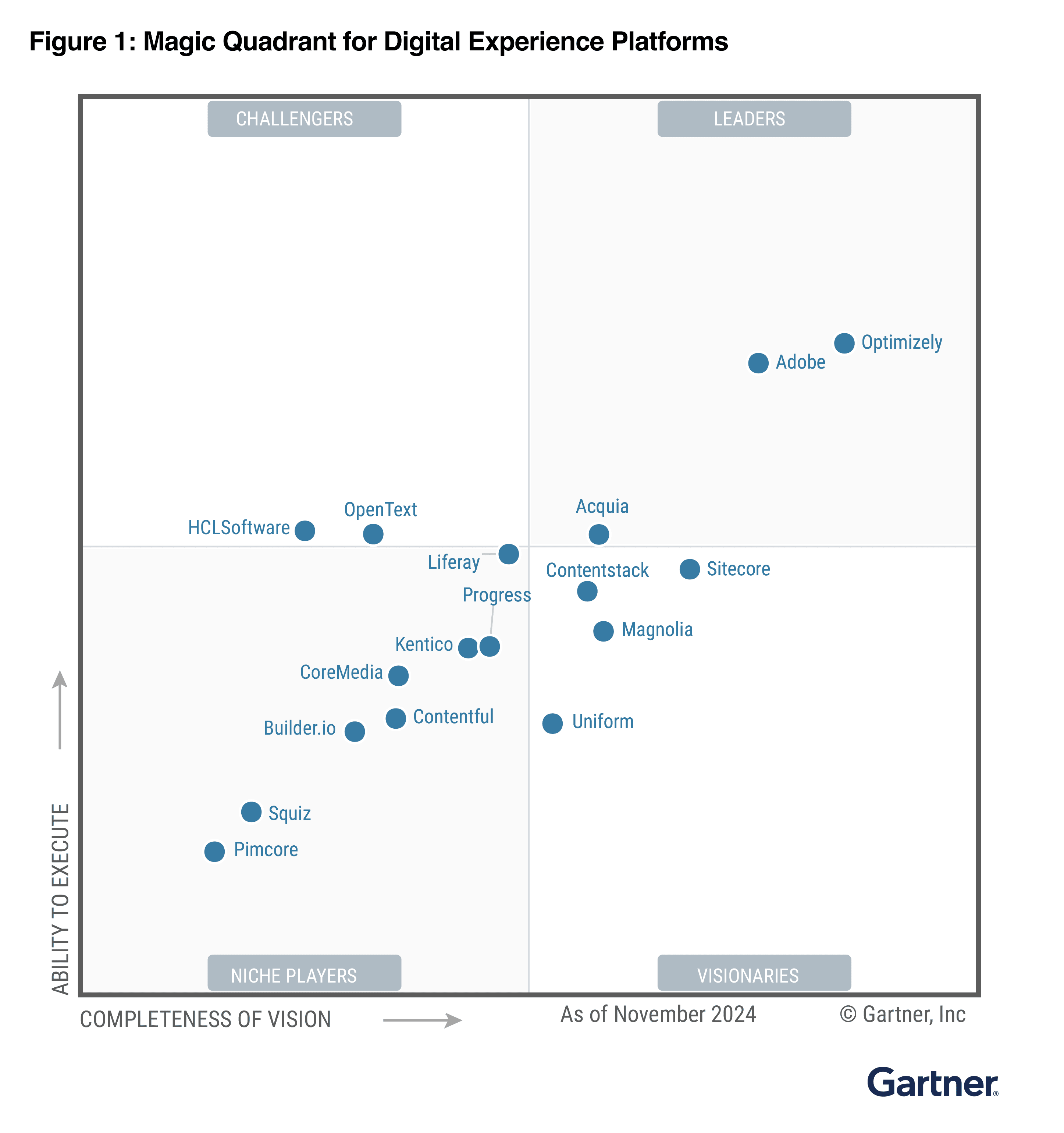
Uniform Recognized as a Visionary in 2025 Gartner® Magic Quadrant™ for Digital Experience Platforms
Learn More