






.svg)

.jpg)














Uniform blog/The architecture problem hiding inside AI success stories
The architecture problem hiding inside AI success stories
.png&w=256&q=75)
The architecture problem hiding inside AI success stories
TL;DR
Many organizations struggle to scale AI beyond isolated success stories, highlighting the hidden architecture challenges that block enterprise impact. True value comes not from simply adding AI, but from adopting composable architecture that allows AI to act across integrated systems. The key takeaway: organizations realizing AI's full ROI are those whose technology stack enables seamless, system-wide AI workflows, not just tool-based automation.
Ninety-one percent of mid-market companies now use generative AI. Ninety-two percent of those same companies report implementation challenges. Both numbers come from the same RSM 2025 Middle Market AI Survey, and they describe the same organizations.
The enterprise pattern is identical. McKinsey's 2025 State of AI reports that 88% of organizations use AI in at least one business function. Nearly two-thirds have not begun scaling AI across the enterprise. Only 7% report AI fully scaled organization-wide. The gap between "using AI" and "AI delivering enterprise-level value" is widening with complexity.
How the symptoms appear across organization sizes
The symptoms surface differently depending on the scale of operations, but the underlying failure mode is consistent.
Small businesses experience it as tool fragmentation. Over 90% use at least one AI tool, but the tools operate in isolation. The ChatGPT subscription that accelerates blog drafting does not connect to the email platform, the analytics dashboard, or the customer data that would make the content targeted rather than generic. Speed improves. Relevance does not.
Mid-market organizations experience it as the readiness paradox. RSM found that 88% of mid-market firms report AI impacted their organizations more positively than expected, yet 53% describe themselves as only "somewhat prepared" to implement AI effectively. Marketing teams adopt AI for content generation while the data quality, integration architecture, and workflow design required for AI to operate across functions remain unresolved. Seventy percent of mid-market companies recognize the need for external support to maximize AI value.
Enterprise organizations experience it as pilot purgatory. McKinsey's research describes the pattern precisely: organizations deploy AI in multiple business functions, report promising use-case-level results, but cannot translate those results into enterprise EBIT impact. Only 39% of organizations report any EBIT contribution from AI, and most estimate the contribution at less than 5%. The pilots multiply. The enterprise transformation stalls.
The common misdiagnosis
When AI adoption succeeds at the task level but fails at the enterprise level, organizations reach for familiar explanations. Training deficits. Change management gaps. Talent shortages. The RSM survey confirms that skills gaps rank among the top implementation challenges. The instinct is to solve the scaling problem by investing in people.
Skills and change management matter, but McKinsey's research points to a different variable as the strongest predictor of AI value at scale: workflow redesign has the biggest effect on an organization's ability to see EBIT impact from generative AI use. High-performing organizations are nearly three times as likely as others to fundamentally redesign workflows around AI capabilities rather than inserting AI into existing processes.
Organizations that bolt AI onto architectures designed for manual sequential workflows inherit the friction those architectures were built to manage. Training people to use AI tools faster does not remove the integration barriers that prevent AI from acting across connected systems.
The architectural root cause
The pattern becomes legible when examined through the martech stack. Enterprise marketing organizations operate across CMS platforms, DAM solutions, CDPs, commerce engines, analytics tools, and personalization systems. The integration architecture between those systems determines whether AI can reach across them or remains confined to one platform at a time.
When 85% of digital experience platform implementation effort is consumed by system integrations, the AI capabilities that vendors demonstrate in product demos become theoretical for most buyers. In a monolithic world, AI is an expensive passenger on an already overloaded ship.
In a composable world, it is the engine. The AI works within a single system. The value lives in the connections between systems. An AI agent that can generate content variations but cannot access visitor classification data, deliver personalized experiences at the edge, and measure conversion impact across channels produces speed without producing revenue.
Composable architecture eliminates the integration burden. When the martech stack is assembled through API-connected, interchangeable capabilities rather than monolithic suites, AI operates across every connected source from day one:
- Over 70 pre-built integrations spanning CMS, DAM, CDP, commerce, analytics, and AI platforms remove custom integration from the critical path
- Configuration replaces code, enabling the MCP Server, essentially a universal translator for AI, to give agents read, write, and create access across the entire composition layer through natural language
- A visual workspace surfaces content from multiple connected sources in a single canvas, enabling marketing teams to assemble, personalize, test, and publish without filing development requests
The workflow redesign McKinsey identifies as the strongest predictor of AI value becomes achievable when the architecture supports it. The difference is concrete:
- Before: a marketer drafts content in an AI tool, manually copies it into the CMS, manually tags it for the CDP, and files a development ticket for an A/B test. Four systems, three handoffs, weeks of elapsed time.
- After: an AI agent suggests a component variation based on CDP data, assembles it in the visual workspace, and triggers an edge-delivered experiment in one conversational step. Same outcome, same day.
The workflow redesign is an architectural capability that the platform provides and the team adopts, not a multi-quarter change management initiative.
The diagnostic question for IT leaders evaluating AI readiness
The Wharton 2025 AI Adoption Report found that 82% of enterprise leaders now use generative AI weekly, and 72% formally measure ROI. The organizations that will demonstrate enterprise-level AI value are the ones whose architecture allows AI to act across systems, not within them.
The diagnostic question is whether the architecture underneath AI allows it to scale beyond the first use case without a custom integration project for each new capability. Organizations answering "yes" are building a compounding advantage. Those answering "no" are merely automating their technical debt.
Ready to discover how easy and safe AI adoption and utilization can be in the composable world? Schedule time with an expert now.
FAQs
McKinsey identifies workflow redesign as the strongest predictor of enterprise EBIT impact from AI. Most organizations insert AI into existing manual workflows rather than redesigning around AI capabilities.
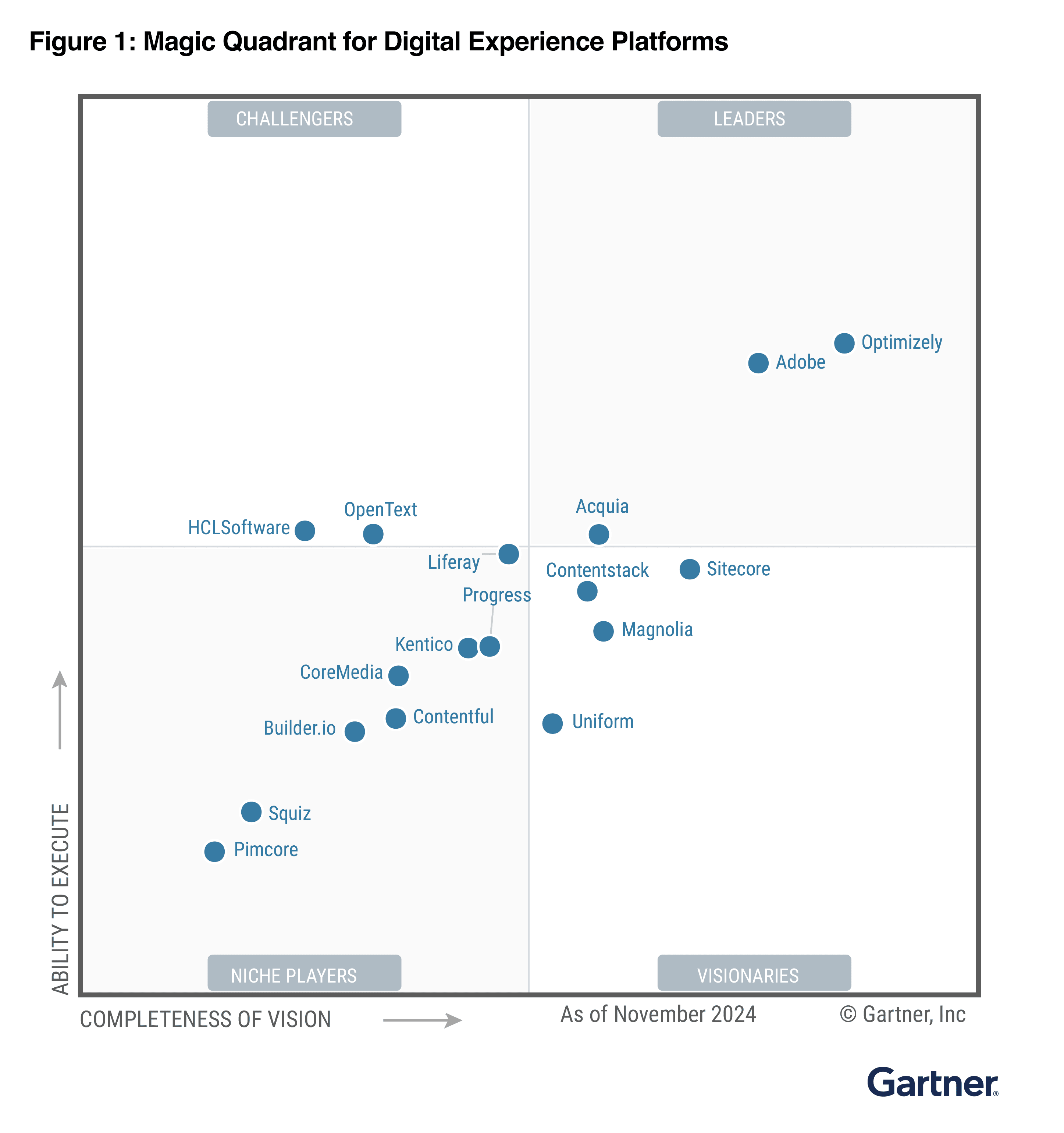
Uniform Recognized as a Visionary in 2025 Gartner® Magic Quadrant™ for Digital Experience Platforms
Learn More