





.svg)

.jpg)













Uniform blog/The independent agentic orchestration layer already exists
The independent agentic orchestration layer already exists
.png&w=256&q=75)
The independent agentic orchestration layer already exists
TL;DR
Vendor-embedded AI agents in MarTech often fail at cross-system orchestration due to siloed automation and integration-heavy architectures. A truly independent orchestration layer—like Uniform’s composable platform—already exists to unify content, data, and workflows across all systems without custom glue code. The key takeaway: organizations achieve scalable, effective agentic AI by adopting a control plane above vendor boundaries, ensuring seamless enterprise-wide automation.
Companies are learning the hard way that most vendor-embedded AI agents are automated workflows dressed up with good marketing. Promotion across the industry has conflated automation within a platform boundary with universal abilities across an enterprise martech stack, and the cost of this confusion is impacting trust across the industry.
Why do platform-embedded agents fail at cross-system orchestration?
Every major martech vendor now ships agents that operate strongest inside their own platform boundary, with cross-silo reach routed through integration layers rather than native to the agent architecture. Real Story Group research posted in March 2026 documents the pattern: the email agent does not know what the website agent offered, the CRM agent does not know the CDP agent suppressed that customer, and the ad agent does not know the service agent resolved a complaint.
RSG draws a direct line to the personalization wars of the 2010s, when every platform personalized within its own silo while no supplier owned the global picture. AI agent sprawl is the 2026 version of this same architectural failure.
Deloitte's 2025 Emerging Technology Trends study confirms the gap: while 30% of organizations are exploring agentic options and 38% are piloting, only 11% are using these systems in production.
What does the control plane problem look like in practice?
RSG introduces a critical concept: the control plane. Whoever owns the planning logic, policy guardrails, available actions, and the audit trail, owns what the agent can do.
With platform-embedded agents, the control plane sits inside the vendor boundary, scoped to that vendor's objects, workflows, and data model.
When a marketing organization needs an agent that spans the CRM, CDP, ESP, commerce, DAM, and analytics, the platform vendor's answer is predictable:
- Purchase the middleware
- Configure the connectors
- Fund the implementation
Cross-silo orchestration becomes a custom integration project.
RSG identifies the DIY engineering path as the alternative: open-source frameworks like CrewAI and LangGraph that let organizations build and own their own control plane. The structural advantages for cross-system work are real, but these frameworks solve the plumbing problem for engineering teams. They do not solve the dashboard problem. Marketing teams need a composition layer that connects content, commerce, personalization, and delivery across systems without requiring code to access it.
Where does composable orchestration close the gap?
The independent orchestration layer RSG describes exists in production. Uniform's composition layer sits above individual platforms rather than inside any one of them, providing the cross-system control plane without requiring custom agent infrastructure built from developer toolkits.
More than 70 pre-built integrations across CMS, commerce, DAM, CDP, analytics, and AI platforms create the connected surface area agents need to operate natively across systems. Scout, Uniform's agentic AI, acts on that surface area in a single conversational workflow: creating landing pages, personalizing content for regional segments, configuring A/B tests, and optimizing for SEO across CRM data, DAM assets, CMS content, and commerce catalogs simultaneously.
Three architectural components make cross-system agentic delivery possible:
- MCP Server provides 21 tools for reading, writing, and creating operations across the full composition model, extending the same unified control plane to developer workflows and external AI assistants
- Edge delivery at sub-50ms executes personalization decisions at the CDN layer rather than routing through platform-specific processing infrastructure, eliminating the latency that vendor-bound agents introduce
- The Visual Workspace gives marketing teams direct access to the orchestration layer without developer dependency, ensuring agents and humans operate through the same connected data surface
The MACH Alliance recognized this architectural distinction in October 2025 by awarding Uniform both the AI Exchange Builder Badge and Partner Badge, differentiating platforms that build agentic capability into composable architecture from those that bolt AI onto existing boundaries.
How should organizations evaluate agentic architecture?
RSG proposes a concrete evaluation framework worth embedding directly into RFP requirements. Request a demonstration across five to seven systems and evaluate:
Criterion | What to ask the vendor |
Shared context | Does the agent retain CRM customer status while composing an email and selecting a DAM asset in the same workflow? |
Unified run log | Can a single trace show every tool call, data source, and decision across all connected systems? |
Policy enforcement | Are brand guardrails, consent rules, and budget caps enforced across CMS, CDP, and ad platforms simultaneously? |
Degraded mode | What happens to the agent workflow when one connected system (commerce API, DAM, analytics) goes down? |
Vendors that respond with "configure the middleware" or "purchase the connector suite" are confirming that cross-system orchestration is an integration program they sell, not an agent capability they deliver.
The architectural choice facing enterprise IT leaders is where the control plane lives: inside a single vendor's boundary, inside a custom framework engineering teams must maintain, or inside a composable orchestration layer purpose-built for digital experience delivery. Organizations that answer that question with architecture rather than procurement will be the ones whose agents deliver across the full martech stack.
Ready to stop stitching integrations and start owning your control plane? Demand agentic orchestration that lives above vendor boundaries — not inside them — so your agents can act across all systems in one unified workflow. Schedule time now to see how true agentic AI works in a composable DXP.
FAQs
Vendor-embedded agents operate within one platform's data model and workflows. Independent orchestration places the control plane above individual platforms, enabling agents to act across CRM, CDP, CMS, commerce, DAM, and analytics through a unified composition layer.
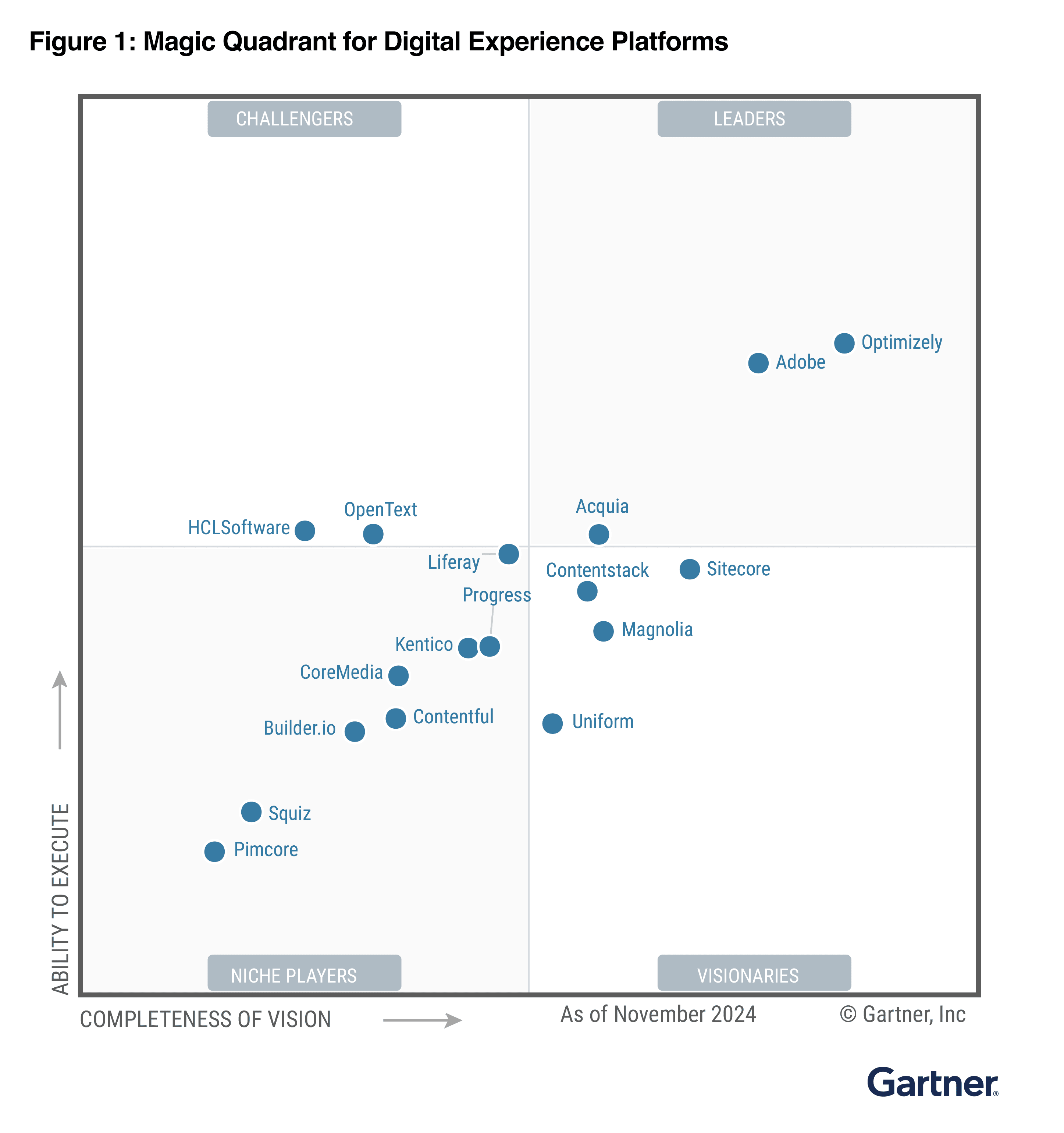
Uniform Recognized as a Visionary in 2025 Gartner® Magic Quadrant™ for Digital Experience Platforms
Learn More