






.svg)

.jpg)











Uniform blog/Orchestration delivers composable’s promises
Orchestration delivers composable’s promises
.png&w=256&q=75)
Orchestration delivers composable’s promises
TL;DR
Orchestration is the missing layer enabling composable digital experience platforms (DXPs) to finally deliver on their promises of speed, flexibility, and marketing autonomy. By uniting all systems, Uniform eliminates costly integration bottlenecks and puts marketers in control without developer dependency. The key takeaway: orchestration, not containment, unlocks true business agility and enterprise scalability for digital teams.
Enterprise marketing teams invest in a new digital experience platform to accelerate campaign delivery, unlock personalization at scale, and free engineering from the content request queue.
Legacy platform vendors structured their pitch around this ambition, then built an architecture that reliably defeats it.
The CMS, analytics engine, commerce layer, and personalization tooling arrive bundled under one contract. Integration complexity does not disappear; it consolidates behind a license agreement that organizations cannot easily exit. The marketing manager who needs a personalized landing page files a developer ticket, waits through a coordination sprint, and reviews the finished template after the campaign window closes.
Conversations on migrating away from legacy DXPs now dominate enterprise evaluations, not because those platforms stopped functioning, but because the cost of staying…
- sheer developer hours consumed by content requests
- integration debt that compounds with every new capability
- campaign velocity surrendered to approval queues
… now exceeds the cost of change. Organizations that replace containment with orchestration recover this velocity.
What does a full-featured DXP deliver?
Legacy vendors defined "full-featured" as owning the database where content lives, the delivery layer on top of it, and the tooling that optimizes it. The promise is that, when one vendor owns every layer, integration between those layers disappears from the customer's to-do list.
The definition holds up in a sales presentation but collapses in production. Marketing teams will still coordinate between the DAM, the commerce system, and the CMS; what’s changed is that all three tools now carry one vendor's logo, one vendor's pricing model, and a contract structure that requires full renegotiation to replace any single component.
A “full-featured” platform does not need to own the database. It needs to own the experience the customer sees, and enable the team responsible for it to build, personalize, and launch the experience without having to file a ticket each time. This architectural distinction separates orchestration from containment and produces measurably different outcomes for every team operating at speed.
The Uniform digital experience platform offers over 70 pre-built integrations, spanning CMSs, commerce, DAMs, CDPs, analytics, and AI tools. Content stays where it lives. Uniform adds omnichannel composition, zero-flicker edge personalization, A/B testing, and Scout, an AI agents who translates entire compositions in seconds, generates A/B test variations from hypotheses, and runs automated SEO audits that fix issues without developer involvement. Each capability activates without the glue code that turns every new addition into a three-month project.
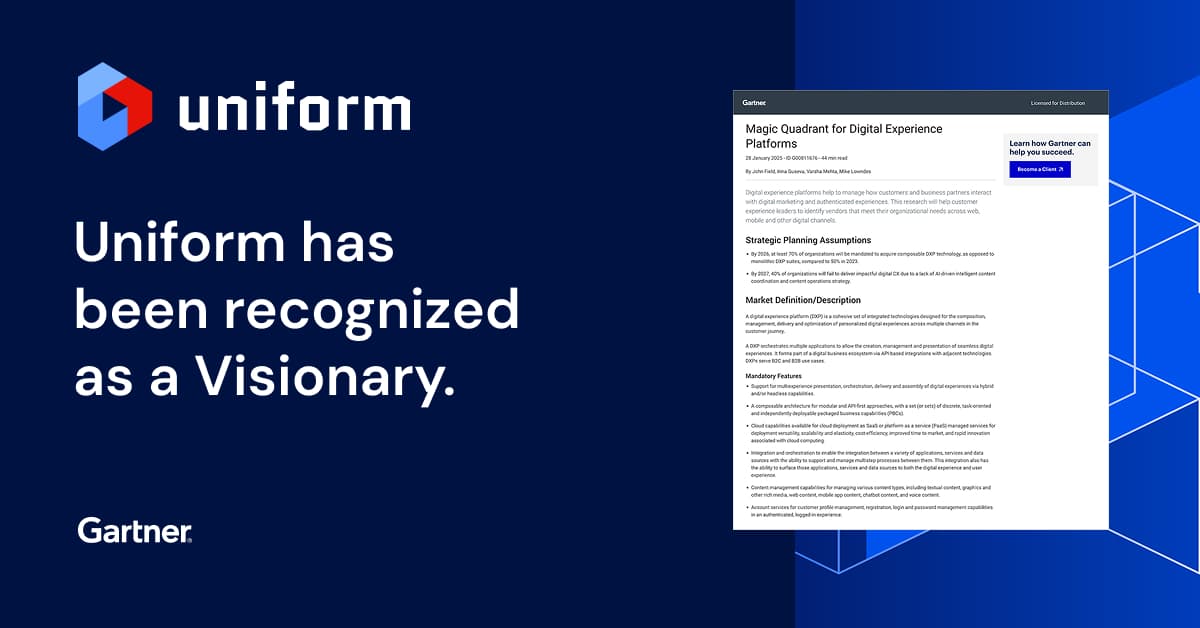
Gartner recognized Uniform as a Visionary in the 2025 Magic Quadrant for Digital Experience Platforms and ranked the platform 4th for composable DXP implementation in the 2025 Critical Capabilities report with a score of 3.86 out of 5.0.
How does the Visual Workspace unlock marketing autonomy?
A marketing manager needs a campaign page combining a hero image from the DAM, a product carousel from the commerce platform, and related articles from the CMS. Under the containment model, the request enters an IT queue on Monday, triggers a backend integration task to coordinate three separate data sources, and waits for a frontend sprint to render the result. The manager reviews the finished template three weeks later. The campaign window has narrowed.
Inside the Uniform Visual Workspace, the same manager opens the UI, selects a hero component, and browses the DAM directly from the sidebar. A product grid component below it surfaces the commerce catalog. Uniform handles the API calls, caching, and performance optimization without developer involvement. The page exists in preview within the same session. No ticket. No sprint.
This difference in workflow represents the shift from a model where marketing depends on engineering to execute every content decision, to one where engineering sets up the composable architecture which marketing operates autonomously. Engineering capacity flows toward infrastructure that differentiates the business. Marketing teams launch campaigns on the business's required timelines, not the platform's permitted timelines.
Why does composable architecture need orchestration to deliver on its promise?
The objection to composable architecture is grounded in real failure patterns. Ten tools from ten vendors, each with its own API, contract, and support model, create a coordination problem that a single-platform approach avoids when no orchestration layer governs the stack.
Uniform is the orchestration layer, and its presence is what separates composable architectures that accelerate delivery from those that redistribute the complexity.
Uniform's governance layer is what makes the composable model operational at enterprise scale:
- Configurable editorial workflows move content through multi-stage approval processes without custom development, keeping governance intact as the martech stack scales.
- Role-based permissions enable regional and global teams to operate within defined boundaries without creating the bottlenecks that slow monolithic platforms.
- Releases and scheduling coordinate content across channels and time zones from a single interface.
- The Visual Workspace surfaces the real-time state of every connected system simultaneously, so teams see exactly what they are building across their DAM, commerce platform, and CMS without switching between tools.
What coordination problem does legacy architecture fail to solve?
Gartner research projects that 40% of organizations will fail to deliver impactful digital customer experiences by 2027 due to a lack of AI-driven content coordination. The failure mode is not the budget or talent–it is architecture.
Containment platforms concentrate complexity rather than eliminate it; AI capabilities bolted onto the same design cannot resolve the coordination failures the architecture produces.
Schedule time now to discuss how the DXP evaluation question has shifted. The question is no longer which platform bundles the most features under one contract. The question is which platform makes the entire composable martech stack governable, visual, and operable by the teams responsible for delivering experiences at the speed the market demands. Orchestration answers this question confidently.
FAQs
Standard implementations reach production in four to six months. Organizations with simpler requirements have launched in as little as two weeks. Uniform runs alongside existing systems during adoption, operating in parallel rather than requiring a complete cutover, which compresses risk and protects campaign continuity throughout the transition.
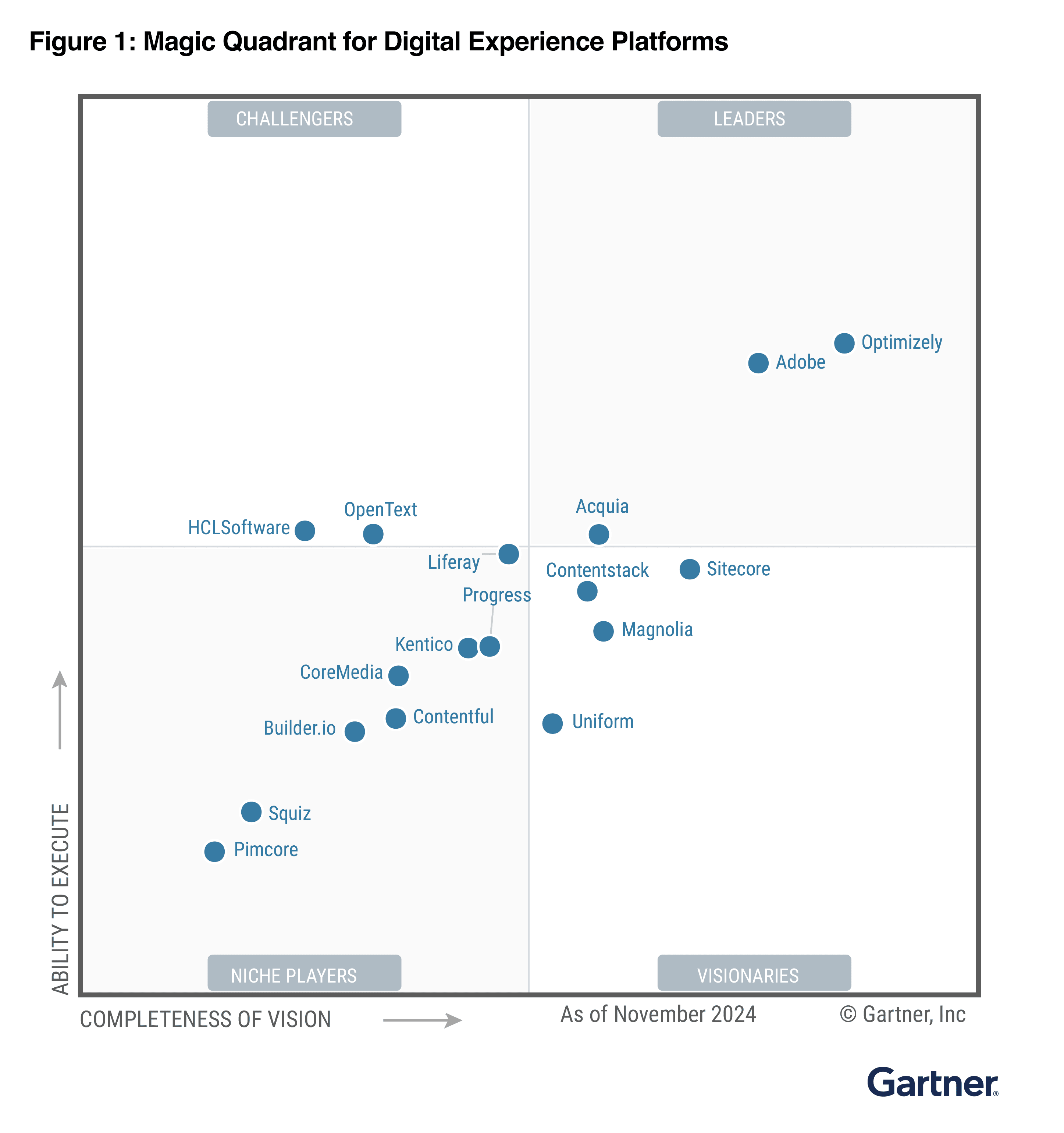
Uniform Recognized as a Visionary in 2025 Gartner® Magic Quadrant™ for Digital Experience Platforms
Learn More